




Today, label embellishment is increasingly built around stable, repeatable processes, hybrid technology configurations that put automation and integration at the core, and a more mature approach to digital production.
Among all the elements that make up a product’s packaging, the label is perhaps the one whose value — not only aesthetic, but above all perceived — is most strongly shaped by the combination of processes and finishes broadly grouped under the term embellishment. Selective coatings that add tactility, metallic effects that catch and reflect the light, raised details, soft-touch finishes and micro-patterns can all make a printed label instantly recognizable and highly appealing.
For the label industry, the main showcase for technological innovation is Labelexpo, the international exhibition held annually, alternating between Europe and the United States. The latest edition highlighted the continued development of a trend already well under way: label embellishment is no longer viewed as an optional finishing stage, but as an integral part of the production process. This shift is being driven by a market in which SKU counts are increasing, run lengths are getting shorter and the number of versions continues to grow. At the same time, personalization is becoming increasingly central to brand strategies, while time-to-market is shrinking.
It is significant that, in this context, the leading trade show for the label industry has broadened its scope to include embellishment for outer packaging as well. The message is clear: premium effects have become a cross-application language spanning labels, sleeves, folding cartons and, in some cases, high-value flexible packaging. Production lines themselves are also becoming increasingly versatile and cross-functional. A typical example is the growing number of systems capable of printing both labels and flexible packaging.
Three drivers making embellishment scalable
If we had to identify three keywords that best describe the current evolution of value-added label production, they would be digitalization, modularity and automation. Digitalization means more than simply designing embellishment effects into the artwork. It means translating them directly into production-ready files, potentially incorporating variable data so that effects can change from one version to another while reducing prepress downtime.
Modularity means building production lines that can evolve in stages, with modules that can be added inline or nearline as production requirements change. This allows converters to adapt capacity to their job mix and to shifts in market demand. Automation, finally, is what makes the whole model sustainable: less reliance on highly skilled operators — who are becoming increasingly difficult to recruit — greater repeatability, guided makeready procedures and tighter waste control.
Hybrid production becomes the standard
Conventional embellishment techniques remain the benchmark where high productivity, heavy coverage or substantial tactile effects are required over long runs. This includes high-build screen printing and coating, as well as applications demanding particularly high quality standards, such as hot-foil stamping combined with specific decorative or artistic processes. At the other end of the spectrum, the economics of micro-runs increasingly favour digital finishing.
By eliminating the need for screens and printing plates, digital technologies shorten makeready and make premium finishing commercially viable even on short runs. The result is a convergence of digital modules, conventional units and integrated converting functions. Hybrid production-line configurations are therefore no longer a technological exception. They are becoming an increasingly common sight in label converters’ pressrooms. One consequence of this evolution is the componentization of embellishment.
The market is no longer centred solely on complete production lines, but also on modules and printbars designed to be integrated into existing equipment. In practical terms, premium effects are becoming process components: flexible, modular and relatively easy to add to an existing production line. This opens up new opportunities for converters looking to test new market niches or enter premium segments without redesigning their entire production workflow.
Embellishment on demand
One of the most mature trends is digital roll-to-roll finishing, where spot UV coatings, selective varnishes and high-build coatings can be applied in register within a continuous production process. The objective is no longer simply to create a “wow” effect, but to make that effect repeatable through controlled process parameters, stored recipes, rapid setups and stable registration.
Digital metallization follows the same logic. A selectively deposited layer can also act as an adhesive, allowing foil to be transferred only where required and enabling fine details and greater creative freedom across short and medium runs. In this way, embellishment becomes more accessible because its economics are less dependent on setup costs and more closely aligned with an industrial production model.
There is, however, an important technical consideration: results depend heavily on substrate preparation, the use of primers where necessary, and compatibility between inks, coatings, adhesives and liners. Embellishment therefore also requires greater standardization of materials, particularly when working with films, uncoated or natural papers and specialty substrates.
Tactile effects, meanwhile, are no longer a niche. Textures, multi-layer raised effects, gloss/matt contrasts and soft-touch finishes create an immediate and, above all, memorable perception of quality. At the latest Labelexpo, development was increasingly focused on sophisticated micro-details: fine patterns, localized effects and material combinations that transform the label into an object designed not only to be seen, but also to be touched.

Digital embellishment
Another established practice among label converters is the use of mixed printing technologies in what the industry often refers to as a second pass. This typically involves printing four-color process work offset first, then running the web through the press again using digital systems that can add varnishes, specialty colors, gold or silver effects. This approach is now widely used because the latest generation of digital presses is capable not only of producing high-impact special effects, but also of delivering increasingly high productivity and accurate registration. That level of registration accuracy is essential to achieving premium-quality results while maintaining competitive production times and margins.
The growth of digital embellishment is also closely linked to the rise of tool-less converting. Digital cutting and laser die-cutting reduce many of the constraints typically associated with short runs, accelerate changeovers and make complex shapes or frequently changing versions more practical. Eliminating — or at least reducing — dependence on physical dies becomes a significant competitive advantage when the daily job mix is constantly changing.
But the real breakthrough lies in integrated process control. 100% inspection, registration monitoring, increasingly automated waste-matrix handling and closed-loop control systems all help reduce process drift and make embellishment more industrial and predictable. A premium effect is profitable only if it is consistent. Quality must be repeatable, not occasional. The same control infrastructure also helps reduce makeready, rewinding operations, film consumption and coating waste, while supporting the growing use of protective topcoats and, where technically compatible, water-based formulations.
Benefits across end-use markets
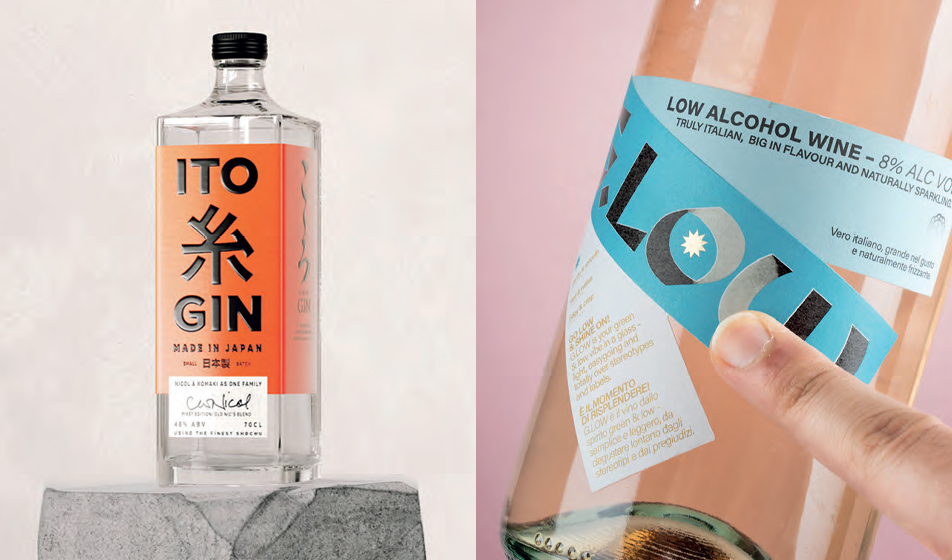
As embellishment becomes mainstream, it is creating value across a wide range of application sectors. In wine & spirits and beauty, it is about brand experience: the label must attract attention on shelf and communicate positioning. In specialty food and limited editions, it becomes storytelling, supporting variants, seasonal campaigns, personalization and co-marketing initiatives. In industrial applications, embellishment is about performance: resistance, durability, legibility and protection.
At the same time, a cross-sector area is emerging around security and accessibility, where micro-patterns, tactile effects and functional finishes can support both inclusive design and anti-counterfeiting strategies. Today, the question is no longer whether embellishment should be applied, but how it should be designed: how to select the right technology for the job mix, how to build an upgradable production platform and how to put automation at the centre of the process. Embellishment is increasingly expected to be repeatable and industrially controlled. And ultimately, the most effective label is one where the technology itself goes unnoticed — but its result is immediately felt.