


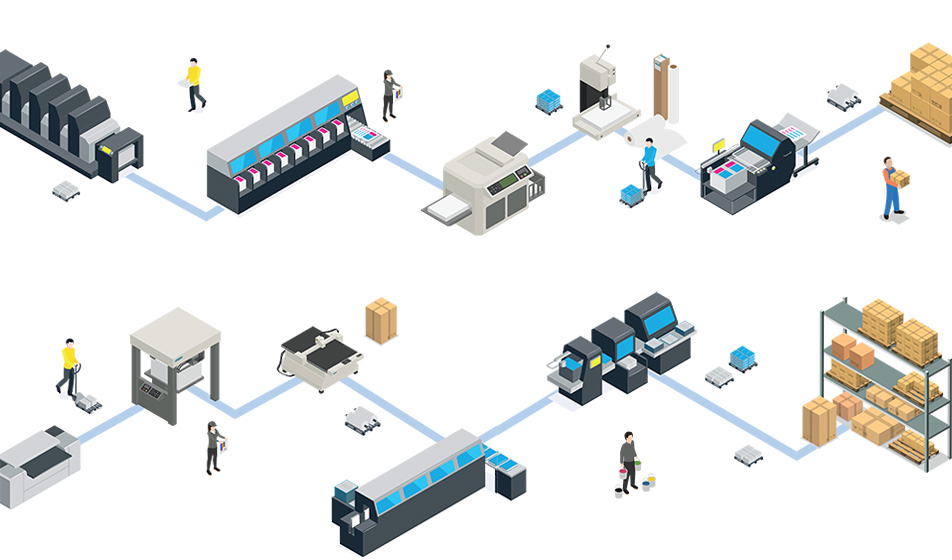
From corrugated board to folding cartons, from wrapped rigid boxes to labels, a new production paradigm is opening up significant opportunities for the packaging industry. Short runs, limited editions, on-demand packaging and online printing services are all pushing converters towards increasingly automated, digital and data-driven workflows. Automation has now reached a new level of maturity. Traditional steps such as printing, embellishment, cutting, creasing, folding, gluing, quality inspection and logistics are beginning to converge into integrated production flows in which machines, software and data operate as part of the same system.
The “box-out” model — moving from raw material or a semi-finished substrate all the way to a finished box — is already a complete end-to-end process in some applications. Elsewhere, it takes the form of modular lines, interconnected production cells or digital ecosystems in which machines communicate by sharing data, job parameters and control information.
The idea of “blank sheet to printed box” captures this shift particularly well. In corrugated packaging, it can mean starting with a plain sheet and ending with a box that has been printed, cut, creased, glued and formed. In folding carton production, it means connecting printing, embellishment, die-cutting and folding-gluing. In rigid packaging, it involves automating box forming, wrapping and finishing. In flexible packaging, it can combine digital printing, embellishment and tool-less cutting.
The market is driving the shift
Brand owners, retailers, food, cosmetics and pharmaceutical companies, e-commerce operators and direct-to-consumer businesses are asking for more frequent runs, greater product differentiation and ever-shorter delivery times. Run lengths are shrinking, the number of variants is increasing, campaigns are becoming more targeted and time-to-market is being compressed. Promotional packaging, different language versions, localized packs, customization by sales channel, seasonal editions, limited runs and market tests are all putting pressure on a production model originally designed around long runs and separate production stages. Traditional production remains extremely efficient when jobs are repetitive and standardized. But as value increasingly shifts towards speed, flexibility, personalization and the ability to handle many different jobs with minimal makeready, integration becomes strategic. The factory itself becomes more compact, departments become interconnected, and value moves away from the individual production step towards the ability to manage the entire workflow — from order intake to finished product.
The “box-out” model was born in corrugated
Corrugated packaging is where integration has reached some of its most advanced forms. The main drivers are e-commerce, logistics and the need to produce packaging that is sized more closely to the actual contents.
Systems are emerging that can start with a plain corrugated sheet and carry out, in sequence, inkjet printing, cutting, creasing, folding, gluing and box forming. Here, integration is not only technological but also logistical: every individual box can become a direct response to a specific order. The system can generate made-to-measure packaging, reduce empty space, limit the need for void-fill materials, optimize transport and dramatically reduce the need to hold dozens of different box sizes in stock. The box is no longer simply a container. It becomes a variable output linked to order, product, customer and shipping data. Looking ahead, the same workflow could incorporate personalized graphics, logistics codes, promotional content, traceability information and messages tailored to the final destination.
Alongside systems that go all the way to the finished, formed box, other approaches are integrating printing further upstream, directly into corrugated-board manufacturing or converting processes. Further downstream, dedicated AI-based software can also optimize palletizing, even when boxes of different sizes are being handled. The goal is the same: to eliminate intermediate steps and bring substrate production, decoration, converting and logistics closer together.
Packaging on demand, limited editions and micro-campaigns
On-demand packaging originally emerged from a simple requirement: produce the package only when it is needed, in the right size, while avoiding unnecessary inventory, waste and oversized boxes. Today, that logic is expanding beyond logistics and into communication. Producing on demand now means being able to create different packages within the same production flow, including different printed graphics, promotional messages, unique codes, languages, destinations, traceability data and personalized content.
Integrating digital printing with converting makes it possible to achieve things that would be more complex, expensive or inefficient in separate workflows. Integrated production is also closely linked to the rise of limited editions.
Integrated lines make it possible to produce promotional or seasonal packaging with fewer makereadies and shorter turnaround times. Digital printing enables graphic variation; digital or automated die-cutting reduces structural constraints; inline embellishment adds visual and tactile value; and automated quality control ensures consistency even across highly fragmented jobs. In this environment, packaging becomes a flexible medium — one that can be updated, segmented and adapted. A box or carton can change according to market, sales channel, season, target audience or even the individual order.
Folding cartons: integration as an ecosystem
In folding-carton applications, the path towards integration is different from that of corrugated packaging. Here, the idea of a single all-in-one machine runs up against constraints involving formats, speeds, board grammages, finishing complexity, die-line management and the sheer variety of applications.
As a result, the concept of an integrated ecosystem is gaining ground. A folding-carton line increasingly links offset or digital printing, embellishment, quality inspection, die-cutting, stripping, blank separation and folding-gluing. The real innovation is not necessarily the physical merging of every production stage, but their digital connection. Machines share data, settings, registration information, job profiles and inspection data. The production file does more than define the print job: it accompanies the product throughout the entire manufacturing cycle. In this model, integration is first and foremost about process management. Job changeovers become faster. Quality control progressively moves inline. Defects and waste can be identified before unnecessary value is added to them. And the operator’s role shifts away from manually adjusting individual machines towards supervising the production system as a whole.
Folding-carton production also has to cope with an extremely wide variety of products: pharmaceutical cartons, cosmetic packaging, food packs, sleeves, displays, promotional boxes, kits and multipacks. Each segment has different requirements in terms of quality, safety, embellishment, inspection and productivity. For this reason, the most effective model is often the connected factory, in which individual technologies are coordinated through workflows, automation and shared data.
Rigid packaging: flexibility is the next frontier
In rigid and wrapped boxes, integration is already more mature. Premium-packaging lines have long combined several stages, including box forming, positioning, gluing, wrapping, turn-in, pressing and finishing. The challenge in this sector is therefore no longer to prove that integration is possible, but to make it more flexible. Rigid packaging is often associated with high-value products, costly materials, special formats and extremely demanding aesthetic standards. Manual craftsmanship has traditionally played a major role, particularly in luxury boxes, presentation cases, wrapped cartons and more complex constructions. New production lines aim to reduce this dependence by introducing faster format changeovers, assisted settings, automated material feeding and more precise quality control. Here too, an on-demand logic is emerging: the ability to manage smaller runs, more frequent variants and greater personalization without sacrificing efficiency. The value of process optimization lies above all in repeatability — the ability to achieve the same quality level across different production runs, with less waste and fewer manual interventions. For rigid packaging, integration can be especially attractive for limited editions, gift boxes, cosmetics launches, premium beverages, consumer electronics and other high-end products. In these markets, the package itself contributes directly to the perceived value of the product. The ability to manufacture special versions, premium packs or promotional series with shorter lead times can therefore create new opportunities for higher margins.
Digital die-cutting and embellishment: the modular paradigm
Digital die-cutting is a key component in integrating printing and converting because it allows manufacturers to move directly from digital file to cut shape without using conventional physical dies. Lasers, digitally controlled tools and die-less systems reduce makeready time, setup costs and production constraints, particularly for short runs, prototypes, versioned campaigns and personalized applications.
Within an integrated workflow, the structural design follows the graphic file, registration can be managed automatically, creasing can be adapted to the material and job changeovers become faster. The benefits are particularly clear when different shapes, personalized cartons, promotional packs, product trials and short runs are required. The same principle is behind modular lines that combine digital printing, embellishment and cutting in a single synchronized sequence. These lines can include spot coatings, tactile effects, digital foil, primers, laser cutting, kiss-cutting, inspection and rewinding. Already well established in labels, this model is now expanding into lightweight packaging, sleeves, small boxes and promotional applications, making limited editions, mock-ups, seasonal packaging and short premium runs economically viable.
Web-to-print: integration becomes a service model
One of the areas where integration between printing and converting could create the greatest competitive advantage is web-to-print for packaging. Until now, web-to-print has developed mainly in commercial printing, wide-format printing, labels and selected standardized products. Packaging has been slower to adopt it because of its greater technical complexity, but the new generation of integrated lines could change that. Web-to-print requires configurable products, automated quoting, files that can be checked automatically, predictable lead times and repeatable processes. These are difficult to manage efficiently when production remains fragmented across separate departments and relies heavily on manual handovers. Integrated workflows make it easier to build a digital packaging catalogue comprising customizable standard boxes, short-run cartons, sleeves, displays, basic presentation boxes, matching labels, promotional packaging and e-commerce materials.
Data becomes the new production tool
In integrated packaging production, true automation does not come from hardware alone. It depends on the quality of the data. Graphic files, structural designs, job information, color settings, material profiles, inspection codes and finishing instructions all need to converge into a single, consistent input. Data effectively becomes a new production tool. It reduces manual adjustments, accelerates job changeovers and connects estimating, prepress, manufacturing and shipping. An integrated line can only deliver its full potential if the upstream workflow is equally well organized. MIS, ERP, prepress, color management, material libraries, preflight, imposition, nesting and production planning all need to communicate with one another if manual intervention, repeated checks and last-minute corrections are to be avoided. In this environment, prepress itself takes on a different role. It becomes, in effect, industrial process engineering, connecting graphics, structure, material, finishing, cutting and variable data. The die-line must work in coordination with the artwork; embellishment must be matched to the substrate; variable data must be linked to quality control; and the format must be optimized to minimize waste. Much of the production efficiency is therefore determined before printing even begins. A poorly prepared file can slow down the entire workflow. A correctly structured file, by contrast, can automatically drive printing, cutting, inspection and finishing. Data is no longer simply information. It becomes productivity.
Sustainability becomes part of the process
Sustainability also fits naturally into this model. Reducing makeready waste, semi-finished stock, internal handling, warehousing and unnecessary transport means using less material, energy and space. In on-demand packaging in particular, producing only what is needed, in the correct size and with fewer production steps can reduce waste, void-fill materials and shipping volumes. For brands and retailers, this is becoming an increasingly important argument. Sustainability is no longer only about recyclable or certified materials. It is also about measurable process efficiency.
The direction of travel is therefore towards a factory with more efficient, flexible and transparent workflows, where software, automation, inspection systems and data accelerate the journey from order to finished product. On-demand packaging, limited editions and web-to-print clearly demonstrate the value of this transformation. The market is no longer asking only for well-made products. It wants solutions that are fast, personalized, sustainable and accessible. Companies that learn to manage this level of workflow integration will be able to position themselves not simply as manufacturers, but as service partners capable of designing, producing, personalizing and delivering packaging that matches the new pace of the market.