


With “Basta Titoli” (Enough with the headlines) and “Stesso gioco, regole diverse” (Same game, different rules), Savills has launched two campaigns in Italian shopping centres addressing violence and gender inequality. Thousands of stickers, a walk-on board, panels, game pieces and oversized dice have transformed retail spaces into places for engagement and awareness.
It is a community of women, men and people of all identities that promotes initiatives and activities to overcome prejudices based on ethnicity, gender, sexual orientation and disability, through reflection on the themes of diversity, inclusion, accessibility and social justice. It operates specifically within the printing, converting and visual communications industries. The association is part of the network founded in the United States and now active in various countries around the world.
Escalators, mirrors, tables, floors. Surfaces we usually pass by without much attention can become means of communication, provided the message resonates with the place and the people who frequent it.
This is precisely what happened with “Basta Titoli” and “Stesso gioco, regole diverse”, the campaigns organised by Savills to mark 25 November 2025, the International day for the elimination of violence against women, and 8 March 2026 the International women’s day, respectively.
The two projects address different aspects of gender inequality and share the same approach: engaging the public through a physical experience integrated into the everyday life of shopping centres. In both cases, printed materials shaped the concept, defining its language, the duration of engagement and its relationship with the space.
Stickers in various sizes, walk-on displays, information panels, giant pawns and dice were designed as active components of the campaigns. The project involved Savills and Yawcom Media Builders in a process that interwove strategy, graphic design, material selection, production, distribution and installation.
Savills and the management of retail spaces
Savills is an international property consultancy group, founded in the United Kingdom in 1855 and also operating in Italy, providing services to property investors, owners and occupiers. In the retail sector, its activities include, amongst other things, the management and enhancement of shopping centres and retail parks, covering property, technical, commercial and marketing aspects. From this perspective, the shopping centre takes on a role that goes beyond the strictly commercial. Particularly in small to medium-sized urban centres, it often serves as a permanent meeting place, frequented by families, young people and the elderly. It hosts events, services, entertainment and community-focused initiatives.
During FESPA Italia Day 2026, Alice Usai, Senior Retail Marketing Consultant at Savills, and Sonia Coppolaro, Business Development Manager at Yawcom Media Builders, described these spaces as communication channels with distinct characteristics. Shopping centres feature large floor areas, high footfall and numerous points of contact with visitors. Their identity also stems from shared activities, independent of the commercial strategies of individual shops. Building on this, Savills develops marketing plans to strengthen ties with local communities. Events and promotions boost footfall and turnover, whilst awareness campaigns enable the centre to assume public responsibility and engage in the debate on issues that directly affect people’s lives.
“Basta Titoli”: before violence becomes news
“Basta Titoli – We need courage, not more news” stems from the realisation that gender-based violence enters the public discourse mainly when it reaches the pages of newspapers. Headlines report on femicides, assaults and abuse only after the events have already taken place. The warning signs that precede them remain far less visible, often present in everyday life as control, isolation, economic dependence, belittlement and psychological abuse.
The campaign brought this message to 15 shopping centres managed by Savills, spread across Italy. The aim was to pause visitors’ routine activities for a few moments and suggest that violence can manifest itself even in the most familiar places, close to the people with whom we share a space, without knowing their story.
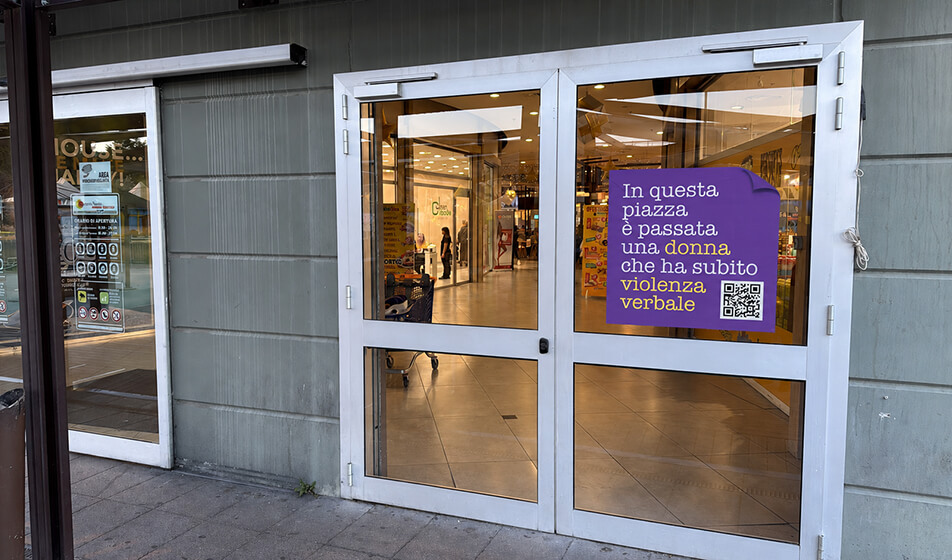
The message “it happened here” appeared on escalators, in lifts, on columns, on tables in food courts, on floors, on doors and on bathroom mirrors. The placement contributed to the meaning of the phrases. Each text was designed with regard to the point at which it would be read, the viewing distance and the time available.
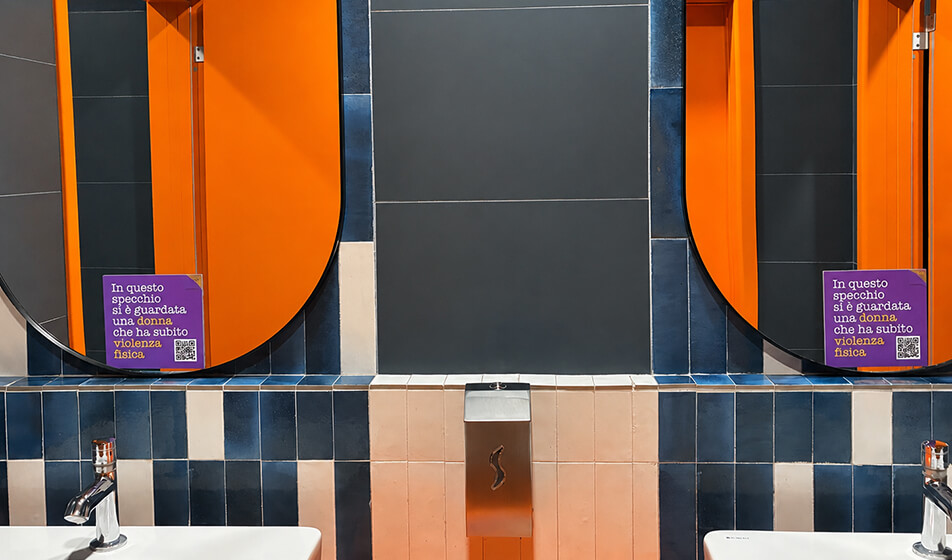
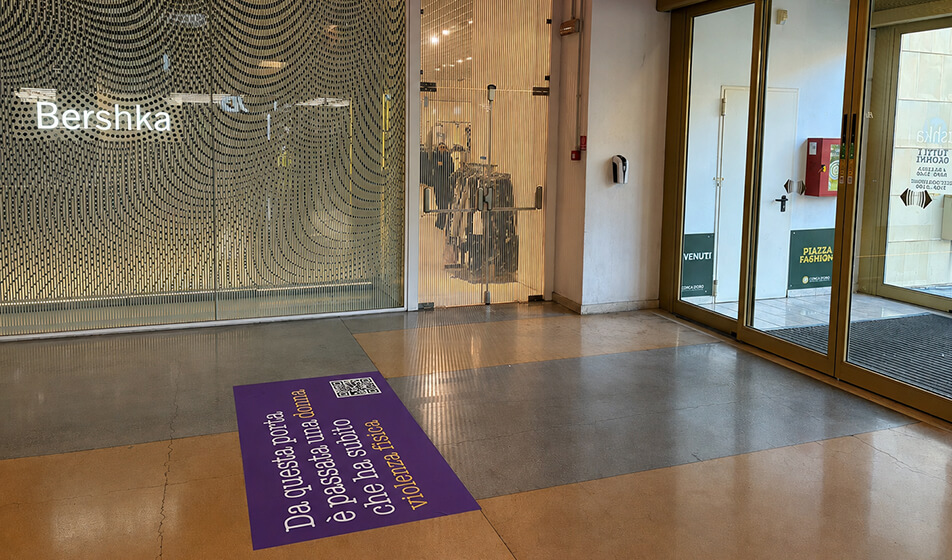
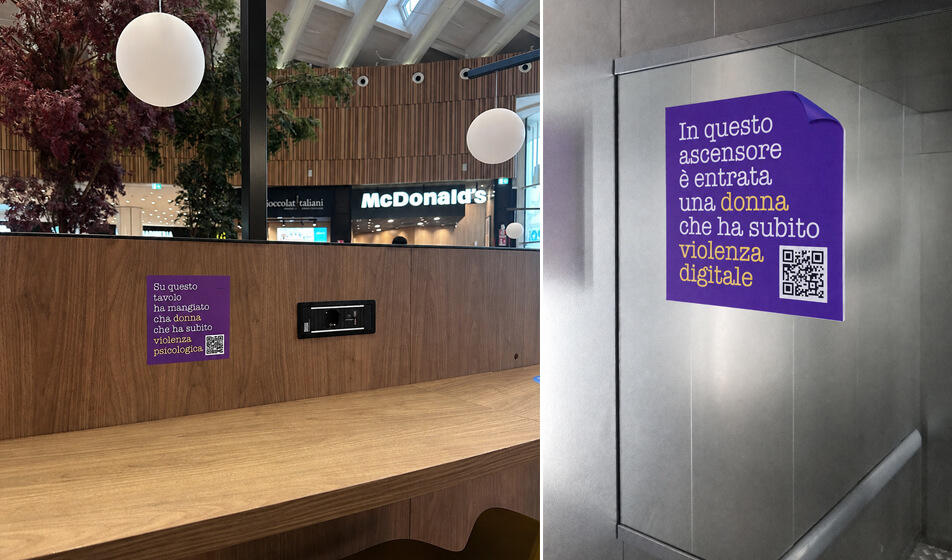
The graphic design was reminiscent of a newspaper layout. Bold typefaces, short headlines and a minimalist layout evoked the news stories that continue to pile up in the daily press. Taken from the page and applied to everyday spaces, those words took on a different sense of immediacy. The campaign was developed with the support of D.i.Re – Donne in Rete contro la violenza (Women’s Network Against Violence), which helped validate the content and the overall design. This collaboration ensured the topic was addressed using the correct terminology and with reliable references.
5,451 stickers in 15 shopping centres
The campaign involved the production and installation of 5,451 stickers in various formats. Such a large-scale roll-out required meticulous adaptation, organisation and quality control. The design therefore took into account the practical conditions of use on surfaces with very different characteristics. Stickers intended for floors had to withstand constant foot traffic whilst maintaining legibility and colour accuracy. On escalators, movement, safety and the limited time available for reading came into play. Mirrors, tables, doors, columns and wall coverings required solutions compatible with specific materials, curvatures and cleaning conditions.
The dimensions were also designed with the environment in mind. The format had to ensure visibility without interfering with the normal use of the spaces. Optimising the dimensions made it possible to minimise waste and keep costs under control. In addition to durability, the materials needed to be applied and removed easily and safely. Installations began simultaneously across multiple locations, so the management and teams at the centres needed to receive elements that were pre-organised, easily recognisable and accompanied by the necessary instructions.
Savills led the concept development, creative direction, relations with the participating shopping centres and supervision of the installations. Yawcom Media Builders managed the formats, graphic design, production, adaptation of the final artwork, printing, logistics and distribution. Collaboration between the two organisations underpinned every stage.
From printed materials to digital resources
Each sticker featured a QR code linking to a dedicated landing page. The page contained up-to-date data, information on the various forms of violence, support tools, and references to anti-violence centres. The experience began in the physical space and continued on the smartphone. The printed slogan caught the eye, and the QR code enabled users to explore the topic in greater depth, recognise warning signs and find useful guidance. The link between printed materials and digital content transformed a widespread exhibition into an accessible information journey.
To support the campaign, a national and local social media editorial plan was developed, comprising teasers, launch content, photographs of the installations, and follow-up stories after the initiative. The centres involved published more than 60 posts, reaching 104,407 users and generating 200,464 impressions and 2,140 interactions.
There were 3,447 QR code scans. During the campaign, the participating venues recorded more than 1.4 million visitors. This figure reflects the potential reach of a project set up within venues already frequented daily by a wide and diverse audience.
8 March, without celebratory platitudes
A few months later, Savills addressed the issue of gender equality to mark 8 March. The starting point was the frequency with which this occasion is associated with well-wishes, discounts, freebies and celebratory initiatives. These are common tropes that rarely help people understand how inequalities affect real-life experiences. The “Stesso gioco, Regole diverse” campaign therefore arose from a desire to make disparities in treatment tangible. To achieve this, the project drew on one of the best-known childhood games: the Game of the Goose. The game board, installed in the centre of the concourse at the Tanit Shopping Centre in Sassari, featured two routes governed by different rules. Men and women started from the same point and encountered the same squares, whilst the instructions varied according to gender. Some participants moved forward; others missed a turn, were forced to stop or had to go back.
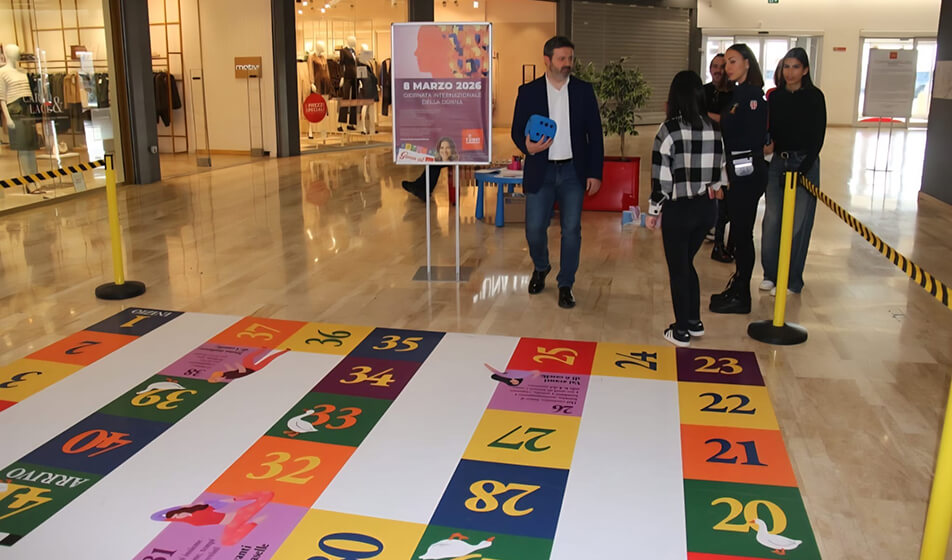
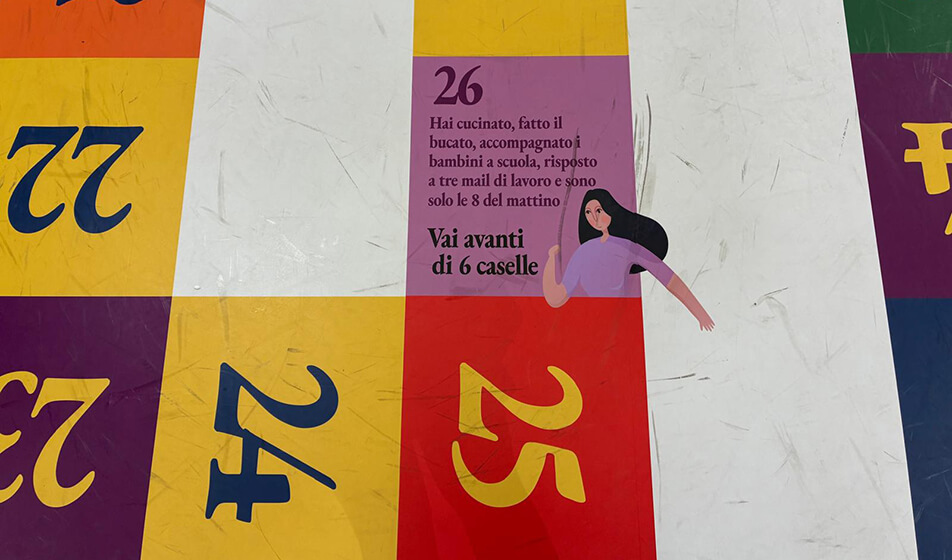
Each move was inspired by situations relating to work, motherhood, the division of household tasks, career opportunities and the judgements that accompany everyday life. The game’s mechanics allowed participants to experience, in just a few minutes, how much slower and more bumpy a journey can become when the rules assign different possibilities.
The gallery took on a new layout for the occasion. Visitors were invited to physically enter the installation, roll the dice and follow the instructions. Understanding the message came through personal experience, movement and interaction with other participants.
A walk-on game board in the centre of the gallery
The production required a large, printed walk-on game board, oversized game pieces, large dice, information panels, and coordinated graphic elements that provided the necessary context for interpreting the experience.
The materials had to withstand repeated use, provide good stability, and be installed without disrupting the centre’s activities. The oversized dimensions made the game visible from a distance and transformed it into a small-scale set open to the public. The response was, above all, participatory. Visitors played the game and directly experienced the differences in treatment. The initiative also attracted the attention of the local community and the mayor of Sassari. On Savills’ channels, the project was presented as an immediate way to demonstrate that men and women can find themselves playing the same game but under different rules.
Designing with production in mind
“Basta Titoli” and “Stesso gioco, regole diverse” take different forms and scales. The first campaign was rolled out across thousands of touchpoints, maintaining a subtle yet persistent presence. The second centred on a large-scale installation designed to attract people and invite participation. Both demonstrate how an understanding of print, materials and installation can shape a project’s development. Formats, surfaces, durability, strength, logistics and installation all helped define how the messages would be received by the public. In Savills’ projects, the shopping centre is understood as a network of spaces, routes and relationships. Print allows us to engage with this network with great flexibility: it can be woven into everyday routines via a small sticker or occupy part of the concourse through a large-scale installation. In the first instance, news reports reach people before an act of violence becomes a headline. In the second, an inequality often described in terms of statistics and percentages is transformed into an obstacle encountered along the way. These are different experiences, united by their ability to bring to the fore what tends to remain in the background.
Girls Who Print Italia
It is a community of women, men, and people of all identities that promotes initiatives and activities aimed at overcoming prejudices related to ethnicity, gender, sexual orientation, and disability, with reflections on the themes of diversity, inclusion, accessibility, and social justice. Specifically, it operates in the printing, converting, and visual communication industries. The association is part of a global network founded in the United States and active in several countries around the world.