



Have you heard of the Infinite Monkey Theorem? Today, that combinatorial mirage has left the realm of science fiction and taken up residence on the servers of the big tech companies. But this is just one of the possible implications of applying artificial intelligence to publishing.
AI-generated image
“All that is needed is a pen that writes automatically, driven by a mechanism that combines characters in every possible way.” So wrote the German mathematician and science fiction writer Kurd Laßwitz in December 1901 in his short story “The Universal Library”. He imagined that, by taking a fixed set of characters, spaces and punctuation marks and combining them in every possible way, a machine would be able to create all texts: an infinite archive, he writes, “not only containing all the lost masterpieces of classical antiquity and the answers to the great mysteries of science, but also the biographies of every human being yet to be born and the legal codes of future civilisations”.
Forty years later, in 1941, Jorge Luis Borges gave shape to this mathematical vertigo in “The Library of Babel”, creating a universe of an indefinite sequence of hexagonal rooms. Crammed within them are all possible 410-page books, generated by the random and disordered combination of the 25 letters of the alphabet. The librarians who inhabit that labyrinth eventually go mad and take their own lives because, for every meaningful line, there are an infinite number of cacophonies, incoherent phrases and linguistic oddities generated by pure chance. Amidst this chaos, a truly comprehensible text remains buried beneath an inextricable statistical background noise.
This story is nothing more than a literary representation of what is commonly known as the Infinite Monkey Theorem: if we leave a monkey in front of a keyboard for an infinite amount of time, sooner or later it will produce Hamlet. The monkey does not know what theatre is, has none of Hamlet’s doubts, nor does it know the rules of syntax: it merely presses keys.
The monkey becomes a parrot
Today, with the advent of AI, that monkey has stopped pressing keys at random; it knows grammar and syntax and has studied millions of texts in thousands of libraries. Today, that combinatorial mirage has left the realm of science fiction and is installed on the servers of the largest tech companies. The automatic pen imagined by Laßwitz is no longer a hypothetical mechanical device, but software accessible to anyone.
Large Language Models (LLMs) and generative artificial intelligence systems, which are revolutionising our approach to work, writing, data analysis, translation, information and study – right down to the simplest web search – operate on a principle that the linguist Emily M. Bender has crystallised in the definition of ‘stochastic parrots’. When an AI generates any text – today, at least (tomorrow is anyone’s guess) – it is not drawing on conscious inspiration, nor is it developing its own critical thinking; rather, within the context of given instructions, it strings words together, repeats patterns, imitates styles and combines linguistic structures, based on the highest statistical probability of one word following another, drawing on an immense corpus of data.
It has no experiences of its own to draw on, only knowledge, to produce output that is as closely aligned as possible with our requests. In short, it responds only when questioned and does so based on our questions. Furthermore, unlike the monkey, what it produces is no longer a chaotic jumble of letters, nor merely a trivial, fluid, plausible and grammatically flawless simulation of human speech, but the statistically most appropriate selection – one that is incredibly effective.
Ever since the public release of ChatGPT 3.5 in November 2022, this technological leap was bound to have an impact on those who make their living from text – namely, the publishing world – which immediately felt under siege, fearing that the value placed on originality and creativity – its primary sources of livelihood – would be undermined and that the very concept of the author (including their rights) would no longer make sense, whilst at the same time being captivated by the allure of unprecedented productive efficiency.
It is therefore time to see “how far into the night we have come”[1].
Beyond the facts, beyond impressions[2]
Let’s start with the figures. According to research by the AIE Research Department presented in January 2026, Italian publishers have already fully grasped what is at stake. Fifty-one per cent fear that AI might ‘hallucinate’ and generate false or entirely fabricated information, yet present it with the confident and impeccable tone of established facts: invented bibliographies, incorrect dates, apocryphal quotations, authors who never existed – yet unwittingly presented by the AI as real facts.
Furthermore, 59 per cent of publishers point to the risk of copyright infringements, particularly during the training phases of language models, which have been developed over years by scouring the web, digital archives and libraries of varying legal status, often without consent and without remuneration (as done by Anthropic, but they are just one of many). Finally, 64 per cent view with concern the impact this technology may have on the work of authors, translators, editors and suppliers. This is not merely a trade union issue, but a structural problem for society: if the way a text is written, translated, proofread, illustrated, promoted or summarised changes, so too do contracts, rights, responsibilities, supply chains and our culture.
Yet, whilst awareness is growing, the regulations are lagging behind. More than 60 per cent of Italian publishing houses have not yet adopted company policies on the use of AI in their workflows, even though they are already using it in some form. Only 18 per cent of publishers have amended their contracts with external collaborators, with figures peaking at 33 per cent in the professional and educational sectors. As regards licences for training models, 72 per cent have no contracts in place, but 59 per cent say they are willing to negotiate – often at rock-bottom prices – should an explicit request come from tech companies. In short, AI has already made its way into publishing houses. There is a desire to curb AI training through rules and regulations, without, however, realising that simply by editing a text in Word, it is already on Meta’s servers even before it becomes a book; by sending it via email or storing it in the cloud, it is also on servers where it is read by Gemini, and so on, from platform to platform. It is feared as a threat yet used as an everyday shortcut.
But there is another aspect that is generally underestimated: the indiscriminate proliferation of books, essays, manuals, guides and novels generated entirely by prompts, written in an authorial tone, yet containing data, dates, quotations and bibliographies that nobody bothers to check.
Books are not merely products, but vehicles of consciousness, and the moment we entrust their production, synthesis and management to probabilistic software, the most serious threat is not, in the medium term, to proofreaders, but the dilution of knowledge.
Platforms such as the Amazon Kindle Store are already experiencing a wave of ‘synthetic’ non-fiction texts, generated in a matter of minutes by AI. Data from major self-publishing platforms, particularly Amazon Kindle Direct Publishing, show that the impact of these books—written openly (or covertly) using AI—is generating an unprecedented crisis of overproduction. Since 2025, Amazon has been forced to make it a permanent, stringent requirement for authors to explicitly state whether texts, images, or translations have been generated by an algorithm, dividing its catalogue into ‘Human-Centric’ and ‘AI-Generated’ or ‘AI-Assisted’ content.
Simply type it in, and the logic engine retrieves it from the central Tank[3]
Market analyses of these sales volumes are bringing the Borgesian paradox to life. On the one hand, the number of titles has skyrocketed, with entire series (primarily novels, self-help books, algorithmic thrillers and travel guides) being produced at a rate of dozens of volumes per month per individual account; on the other hand, actual sales figures show that this abundance does not generate economic value. Indeed, there is a commercial rejection of texts openly written by AI, which manifests itself, on the one hand, in a collapse in perceived value – because readers refuse to pay the standard price for a product they know was generated in a matter of seconds and at no cost – and, on the other, in the saturation of ‘useless’ texts, which are nevertheless given prominence because they are perfectly aligned with the algorithms of e-commerce platforms.
And what of authors and editors? Theirs is not a rejection: 39 per cent, according to the AIE, express curiosity and openness towards AI, even in the creative phase, where it is often used for brainstorming or as an assistant for documentary research. However, 26 per cent express reservations or fears, particularly regarding the risk of stylistic homogenisation and, of course, the infringement of intellectual property rights.
To understand the nature and real limits of this interaction between humans and the ‘stochastic parrot’ in the field of pure writing, creative director Gabriele Moschin and designer Andrea Filippi put the machine’s authorial capabilities to the test as early as 2023 by writing, together with ChatGPT, a collection of poems entitled “Poems from the Thinking Machine”, illustrated in parallel using DALL-E.
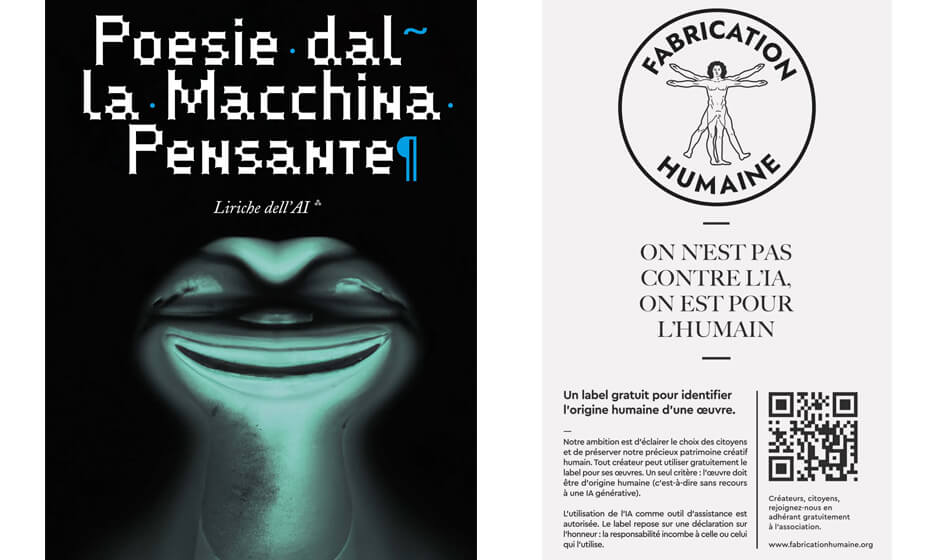
This experiment, published on Amazon within the space of just a few days, offers a perfect insight. “We focused,” say the authors, “on the generation of possibilities – what we call Augmented Imagination – but artistic value arises through their selection, or what we define as Supervised Co-authorship. The machine generates, proposes, deviates, and even makes mistakes; authorship emerges when the human being decides what to retain, what to reject and what to transform.”
The strategy adopted to push the software’s limits and test its creative capacity was particularly interesting: the authors fed the algorithm with generic and deliberately misleading commands, with the explicit aim of driving the machine towards chaos, causing it to make mistakes and diverge from conventional semantics. “We’re not interested in asking the machine to be creative, but rather in understanding how human creativity changes when confronted with a system capable of multiplying possibilities at a speed never before experienced. We felt like co-authors and, provocatively, signed our work as such. At the time, we accepted around 30 per cent of the text outputs and a similar proportion of the images; today, this margin can vary incredibly.” AI, lacking lived experience and existential trauma, ends up producing naïve texts comparable to those of a teenager, relying on stereotypical visions of good feelings and on elementary, predictable rhymes.
Filippi Moschin’s experiment foreshadowed a trend that has since evolved into a structural phenomenon now reaching the publishing industry. To date, the major Italian publishers – driven in part by obvious legal, trade union and brand-positioning considerations – do not explicitly include in their catalogues novels or essays written entirely by AI; however, AI is used – with appropriate disclaimers in the colophons – for covers and graphic design, for digital-first specialist non-fiction series, or for translations.
To date, therefore, the real impact on catalogues is not in books written ‘by’ AI, but in those produced and promoted ‘with’ AI.
We created the Machine to carry out our will[4]
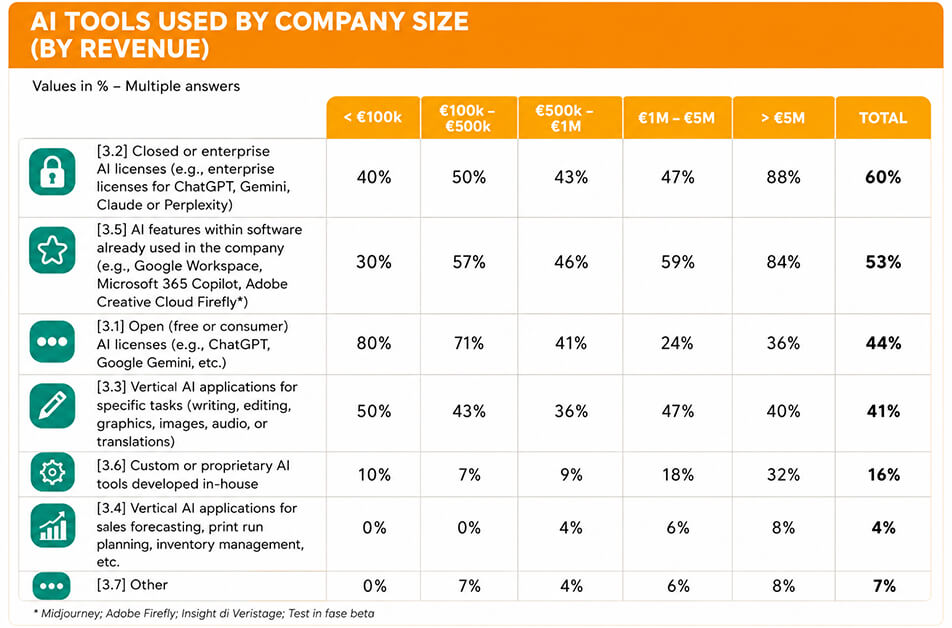
A publishing house’s editorial workflow has long been characterised by a chronic imbalance between the volume of incoming material – from scouting and editorial assessment – and the time available to process it and move on to the production phase. Even at these early stages, AI has enabled genuine macro-textual analysis and evaluation systems. The most interesting tool is Marlowe, developed by the Authors.ai platform. Designed for fiction, it is not a generative AI—it does not write a single line of text—but simply reads and analyses the text, producing a comprehensive analytical report that graphically maps the narrative arc, quantifies the pace and density of dialogue relative to descriptions, traces the characters’ emotional arcs, examines the presence, relationships and psychological and emotional traits of the protagonists throughout the text, and identifies the author’s verbal tics or recurring stylistic clichés. Furthermore, by comparing the manuscript with a vast historical database of global bestsellers, the algorithm can estimate the text’s commercial potential. A great help for an editor, but who knows how Marlowe would cope with revolutionary works that are deliberately unbalanced, asymmetrical or linguistically subversive, such as Joyce’s Ulysses or Cortázar’s Hopscotch?
But the real boost to editorial work comes when AI is applied to the editing and proofreading stages, which involve continuous technical micro-checks. In this context, AI software trained specifically on the text operates with surgical precision that far surpasses the capabilities of the human eye alone. The algorithm is programmed to uncover deep-seated and hidden logical and structural inconsistencies across the hundreds of pages of a book. Furthermore, and just as importantly, AI ensures compliance with editorial standards and checks for double spaces, euphonic ‘d’s, capitalisation, quotation marks, italics and the transliteration of foreign names. Tools such as EuloTech’s ‘Corrige dell’italiana’, ProWritingAid and Paperpal are specialised tools that free the editor from the most mechanical, tedious and alienating aspects of proofreading, leaving them more time for stylistic editing. Even processes prone to a high rate of errors, such as OCR, benefit from AI by going far beyond a simple comparison with a dictionary used as a template; instead, they effectively ‘read’ the text, resolving ambiguous cases and enabling the reactivation of catalogue titles for which no archive exists. It is no coincidence that, according to the AIE’s analysis, almost half of the publishers surveyed have already integrated some form of AI into their text management processes, using it to assist with an initial reading of manuscripts for scouting and selection, for structural editing, and for proofreading. Amazon now makes extensive use of AI to create audiobooks for its Audible service. And with the latest release of Adobe InDesign, version 21.4, AI is also beginning to support page layout, thereby reducing the time spent on repetitive tasks and allowing graphic designers to make creative changes to images and text without having to constantly switch between programmes (such as Photoshop or Illustrator).
Interoperability between AI and professionals has also reached a high level of maturity in the field of translation. Advanced neural-network-based tools, such as DeepL, are being used effectively in technical non-fiction, manuals and professional publishing. In many cases, AI is used to produce a first draft, which is then subjected to human linguistic revision.
And in the publishing industry?
The world of printing is also benefiting from dedicated AI tools. In particular, software such as Enfocus Phoenix or Ultimate Impostrip, designed for the imposition stage, calculates the optimal mathematical combination based on format, print run, type of press (offset vs digital) and finishing options to reduce paper waste to zero. But it is web-to-print solutions in particular that benefit from the advantages of AI: managing high volumes of orders with widely varying technical specifications and quantities requires real-time optimisation for both the quotation stage and production planning; orders are thus processed more quickly and in a predictive manner, anticipating stock-outs. Even more advanced are the so-called AIM (Automatic Inventory Management) and ASR (Automatic Stock Replenishment) systems, which, by monitoring the number and rate of copies sold via AI, calculate the lead time and trigger a reprint at the appropriate moment for the expected number of copies. Ingram Content Group, North America’s largest book distributor, even initiates reprints at the facility closest to where the order was received.
You simply press the keys for what you want to know or see[5]
As in other fields, particularly social media, generative AI is adept at producing communication and marketing texts, as well as paratexts and metadata, in the publishing world. Veristage, a B2B platform focused on the book supply chain, operates in this segment with its Insight module. Its aim is to process PDFs, Word files, ePubs and, shortly, InDesign files within a secure environment that safeguards intellectual property, without the texts being used to train large language models (LLMs).
The AI performs in minutes tasks that would otherwise require hours of work by the press office and marketing department: it analyses the text, extracts metadata and metrics such as page count, character count and reading time; classifies it with extreme precision according to the BISAC and Thema taxonomies; suggests similar published works; and drafts various versions of synopses, back-cover blurbs tailored to different target audiences and channels, press releases for social media and online stores, including SEO-optimised descriptions. In addition, it produces media such as 3D models of the book and promotional images, translates, creates audiobooks and provides the alternative and extended descriptions required by the European Accessibility Act, as well as a chatbot that responds to enquiries about each uploaded text.
There are also more specialised tools, such as Shimmr AI, which, by analysing psychological, emotional, thematic and stylistic nuances (which it calls ‘BookDNA’), generates advertising copy, promotional texts and visual suggestions targeted at a specific niche of readers. It also constantly launches and optimises dynamic adverts on the main digital advertising platforms, managing budgets and target audiences in real time based on conversions and actual sales. The aim is to revitalise the catalogue and generate economic value, partly through micro-revenues.
Processing vast volumes of sales data with AI tools such as K-Lytics or Publisher Rocket, alongside monitoring the review market, discussion topics and changes to competitors’ catalogues, enables publishers to access predictive reports of exceptional clarity. The system can flag the emergence of a new market niche or a sudden surge in interest in a literary subgenre even before it becomes apparent on the official bestseller lists. Furthermore, it supports the sales department by instantly generating promotional and sales materials for the sales network (order forms for booksellers, comparative price analyses, performance reports on similar titles), transforming commercial intuition into a data-driven strategy.
The Guardian of Law Zero
The AI permeating the publishing world is proving to be an extraordinarily powerful tool: whilst on the one hand it frees us from the most repetitive, low-value-added tasks, on the other it demands a deeper level of attention than in other sectors. The risk of flooding the market with empty, bland texts – sterile rewrites offering nothing new – can only lead to a deterioration in the quality of what is on offer. With the advent of AI, Asimov’s vision and his laws of robotics are strikingly relevant today. Not because (chat)bots have taken the place of editors – not yet, at least – but because the question, now as then, remains the same: what can a machine do? Who is accountable for it? And what happens if it is left to act without rules?
AI can help us, but it does not understand what culture is; it does not experience truth; it does not feel the ethical responsibility for its own words; and it lacks the experiences and feelings needed to translate them into works of art. In this sense, AI contravenes not only Asimov’s Three Laws but, above all, the Zeroth Law, which states that “a robot may not injure humanity, nor, through inaction, allow humanity to come to harm”[6]. It contravenes them because whilst it possesses extraordinary abilities and boundless knowledge – perhaps even intelligence – it certainly lacks consciousness, unlike us.
The Three Laws of Robotics according to Filippi Moschin
- Never delegate judgement. A machine can generate possibilities; only the creator can attribute meaning.
- Use AI to expand what is possible, not to replace thought. Artificial intelligence must enhance imagination, not reduce cognitive effort. When it becomes a shortcut, it ceases to be a creative tool and becomes an oracle.
- Be prepared to contradict the machine and yourself. The work arises from the negotiation between human intention, algorithmic deviation and error, within the same ecosystem. The author must steer the dialogue with it.
Implicitly, Filippi Moschin turns Asimov on his head. There, the laws serve to prevent the robot from harming humans; here, they serve to prevent humans from relinquishing their authorial role.
[1] Fruttero & Lucentini, A che punto è la notte, 1979
[2] E. M. Forster, The Machine Stops, 1909
[3] Murray Leinster, A Logician Named Joe, 1946.
[4] E. M. Forster, The Machine Stops, 1909
[5] Murray Leinster, A Logician Named Joe, 1946.
[6] Isaac Asimov, The Robots and the Empire, 1985