




If you are looking for durable growth over the next five years, digital label production should be at the top of your list. Not as a side hustle. Not as a nice add-on. But as a strategic expansion that can fundamentally shift margin profiles and customer relationships.
The label market is no longer defined by long-run flexo commodity work where margins are thin. It is now one of the most dynamic and technology-driven segments in the entire print ecosystem. From regulated pharmaceutical applications to craft beverage brands, from industrial durability requirements to premium retail packaging, labels sit at the intersection of compliance, branding, and supply chain velocity.
And that intersection is expanding.
Functional Labels: Where Compliance Meets Margin
There are many segments that rarely get the glamour shots because they focus on functionality. Think about pharmaceutical, medical device, chemical, and industrial labels. These applications are not about how pretty they are or how they shine. They are about performance.
Pharmaceutical labels require serialization, variable data, microtext clarity, barcode precision, tamper-evident features, and audit trails. Regulatory pressure continues to intensify globally, and track-and-trace mandates are not going away. Every new specialty drug, every clinical trial batch, every dosage variation, and each medical device drives short-run complexity. That complexity favors digital.
Industrial and chemical labeling adds another layer. These labels must survive solvents, abrasion, UV exposure, and extreme temperatures. Adhesives must bond to challenging surfaces. Compliance with GHS hazard standards is non-negotiable. In this segment, printers are not selling ink on substrate. They are selling risk mitigation.
For print service providers with roots in transactional, direct mail, or high-security environments, this is a natural adjacency. The data discipline already exists. The opportunity is to add materials expertise and durable production capability.
These are not low-margin jobs. They are high-responsibility jobs. And responsibility commands margin.
Food and Beverage: The Engine of SKU Proliferation

Now let’s pivot to the segment most printers first associate with labels: food and beverage. The shift here over the last decade has been dramatic. Craft breweries, regional wineries, specialty food startups, and wellness brands have reshaped the market. Product cycles are shorter. Flavor launches are seasonal. Regional SKUs are common. Limited editions are marketing tools.
Flexo plate costs and long makeready times used to limit participation. Digital inkjet changed that equation. Today, profitable short runs are not only possible; they are expected.
Premiumization has added another layer of opportunity. Wine and spirits brands increasingly rely on tactile finishes, raised varnish, matte coatings, and digital foil to differentiate on crowded shelves. Specialty food producers want texture and visual depth. The label is no longer an identifier. It is a brand statement.
Digital embellishment platforms have gained significant traction over the past 12 months. What was once perceived as boutique technology is now part of mainstream label strategy. For mid-sized printers in particular, the ability to add embellishment without expensive tooling is a powerful differentiator.
This is where labels move from commodity to craft.
Retail, Private Label, and the E-commerce Multiplier
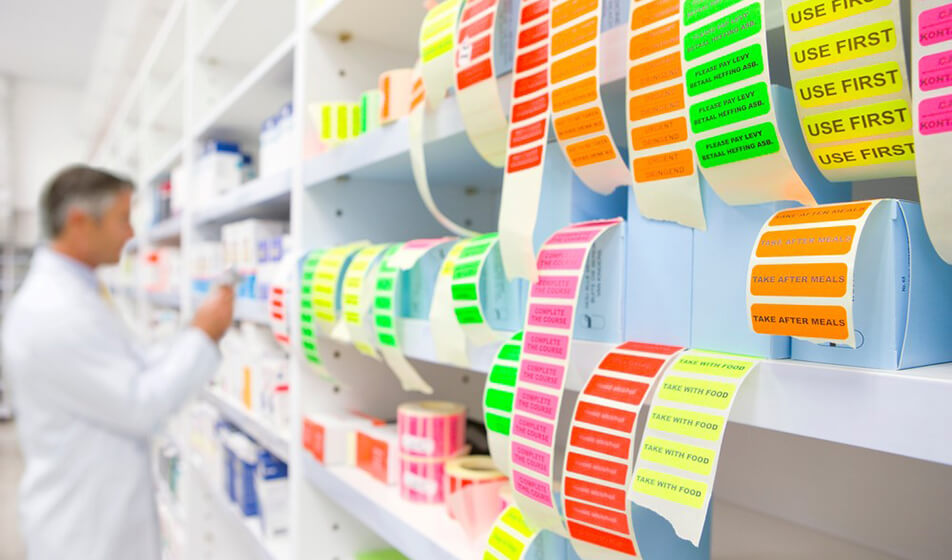
Retail and e-commerce continue to amplify demand for agile label production. Private label brands are expanding. SKU counts are rising. Regional compliance variations are common. Sustainability specifications are tightening.
Digital production allows brand owners to version without inventory waste. It allows retailers to test packaging concepts in market before scaling. It allows direct-to-consumer brands to personalize and iterate.
Logistics labeling also deserves attention. Warehouse barcoding, compliance labels, and shipping applications may not carry premium embellishment margins, but they offer volume stability and recurring demand.
Sustainability is a defining force here. Recyclable liners, wash-off adhesives, linerless formats, and compostable substrates are increasingly required by brands of all sizes and in all regions. Printers that understand how these materials behave in production gain a strategic advantage. This is not simply a substrate swap. It requires testing, process control, and customer education.
Technology Pathways: Entry, Expansion, and Industrial Scale

Not every printer enters labels at the same point. The right technology pathway depends on customer base, capital appetite, and operational maturity.
For small commercial printers, compact roll-fed toner or UV inkjet label systems provide an accessible on-ramp. These devices offer a manageable footprint, minimal training requirements, and an affordable investment. They are ideal for local food startups, event labels, promotional products, and short-run prime work.
The caution is this: entry-level equipment is a market validation tool, not a long-term industrial solution. If the strategy succeeds, scaling plans must follow.
Mid-sized printers often find hybrid platforms especially compelling. Hybrid presses combine digital inkjet units with flexo stations for coatings, specialty inks, or longer-run efficiency. This model bridges economic gaps between short digital runs and more traditional production.
Hybrid adoption has accelerated recently because it allows printers to retain existing flexo strengths while adding digital flexibility. It also supports expanded gamut printing and high-opacity white, both increasingly critical in premium segments.
Industrial-scale converters are pushing even further. High-speed UV inkjet platforms have improved dramatically in reliability over the past year. Recirculating printheads have reduced white ink maintenance challenges. Wider webs and higher native resolutions are expanding application versatility. Inline inspection and automated quality monitoring are becoming standard rather than optional.
The conversation at this level is not about replacing flexo entirely. It is about building digital capacity that competes economically across a wider range of run lengths.
What Has Changed in the Past 12 Months

The last year has been vibrant with new technologies, substrates, and inks coming to market. Three developments stand out.
First, the reliability of white ink has improved significantly. Historically, white ink maintenance deterred some printers from pursuing clear-on-clear or metallic applications. Advances in recirculation technology and ink chemistry have reduced clogging and increased uptime. This has expanded adoption in premium beverage and cosmetic labeling.
Second, digital embellishment has matured. Raised varnish and digital foil systems are more modular, more accessible, and more tightly integrated into label workflows. The ROI conversation has shifted from experimental to practical.
Third, workflow automation has become essential. Label environments involve high SKU counts and frequent version changes. Cloud-enabled MIS systems, automated color libraries, and real-time analytics are reducing errors and accelerating job onboarding. Printers that already embrace automation in commercial or transactional environments find labels a natural extension.
The Strategic Discipline Required
Labels are not forgiving. Registration precision, die cutting accuracy, and color consistency are baseline expectations. Regulatory segments require documented quality controls. Premium segments require aesthetic excellence.
Entering labels is not simply a press purchase. It is a business model shift. Sales teams must understand substrates and compliance in the context of their customers. Production teams must master new finishing requirements. Procurement must build relationships with material suppliers.
The printers who succeed do not try to serve every segment at once. They choose a focus.
Some build defensible niches in pharma or industrial labeling, leveraging data expertise and compliance discipline. Others pursue craft beverage and premium food brands, investing in embellishment and tactile finishes. Still others align with retail and private label growth, emphasizing agility and sustainability.
There is no universal template.
The Real Opportunity
Labels, especially digitally produced labels, represent one of the few segments where technology innovation, regulatory pressure, and brand evolution are all driving demand simultaneously.
Commercial print volumes may fluctuate. Marketing budgets may tighten. But products still need identification. Drugs still require compliant packaging. Food brands still compete for shelf visibility. Retailers still expand private labels. E-commerce still ships.
Labels sit at the center of all of it.
For printers willing to approach the market strategically, align technology with application, and invest in operational discipline, labels offer more than incremental revenue. They offer margin resilience and long-term relevance. The opportunity is not theoretical. It is operational. And for many printing companies, it may be the most important diversification decision of this decade.