



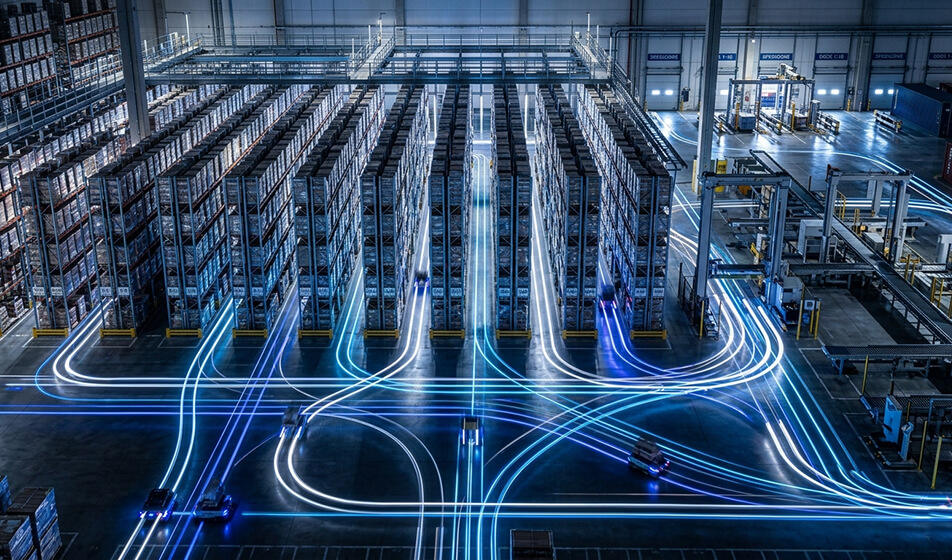
Now that we are moving from experimentation to implementation, AI is proving to have a measurable impact on packaging development when integrated into a complex supply chain. Not so much from a creative perspective – which remains marginal – but in operational, commercial and organisational terms.
We have now become accustomed to using artificial intelligence in its generative form as a creator of text and images, or at most as a tool to aid reasoning, problem-solving, and the analysis of data and scenarios. We have seen it generate concepts and mood boards, suggest layouts, and create multiples and replicas. But now, forget, for a moment, the prompts from Midjourney or the accommodating responses from ChatGPT. In the world of packaging, AI is moving beyond our desktops to enter directly onto the production line, and its most profound impact is not limited to the creative phase. It is measured in the development of packaging by grams saved, reduced volumes, better-calculated strength, errors avoided, damage anticipated, and optimised production flows. In short, the real leap forward concerns not just the final form of the pack, but the entire decision-making system that determines its structure, materials, protection, handling, and impact.
If 2024, as in many other sectors, was a year of experimentation, small-scale trials and understandable caution in the face of a promise yet to be verified, 2025 and the start of 2026 marked a turning point. According to a McKinsey survey published in February 2026, two consecutive surveys focused on the packaging and paper sector reveal a clear acceleration: in 2024, only around a quarter of the companies surveyed reported having launched or developed Gen AI solutions, whilst twelve months later the percentage rose to 82%. The terminology used by McKinsey is also striking: the talk is no longer just of an exploratory phase, but of a shift “from experimentation to execution”. And this is not merely a lexical nuance. It means that the packaging sector – a solid and historically cautious industry – has begun to treat artificial intelligence not merely as yet another trendy tool to test because everyone is talking about it, but as a lever capable of integrating into operational, commercial and organisational functions.
It is no coincidence that the areas where McKinsey records the highest penetration are development, sales, procurement, the supply chain and logistics. In other words, beyond the creative stages where a successful adoption was more easily anticipated, the facts are demonstrating how it is creating real value when integrated into an already complex supply chain, comprising communication strategies, consumers, regulations, materials, machinery, timelines, costs, and reuse, recycling and disposal. Naturally, none of this can be achieved with general-purpose generative tools used in an ad-hoc manner. What is needed are vertical specialisations, models trained on specific data, and systems designed to read process variables and deliver operational decisions. Generating a nice biscuit tin is one thing; optimising an entire packaging supply chain is quite another.
The Amazon case: the dynamic shipping algorithm
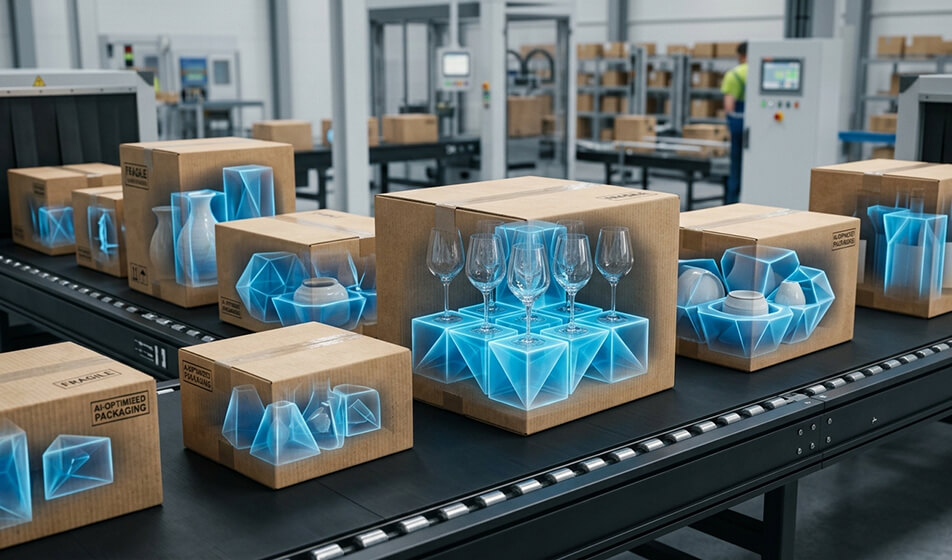
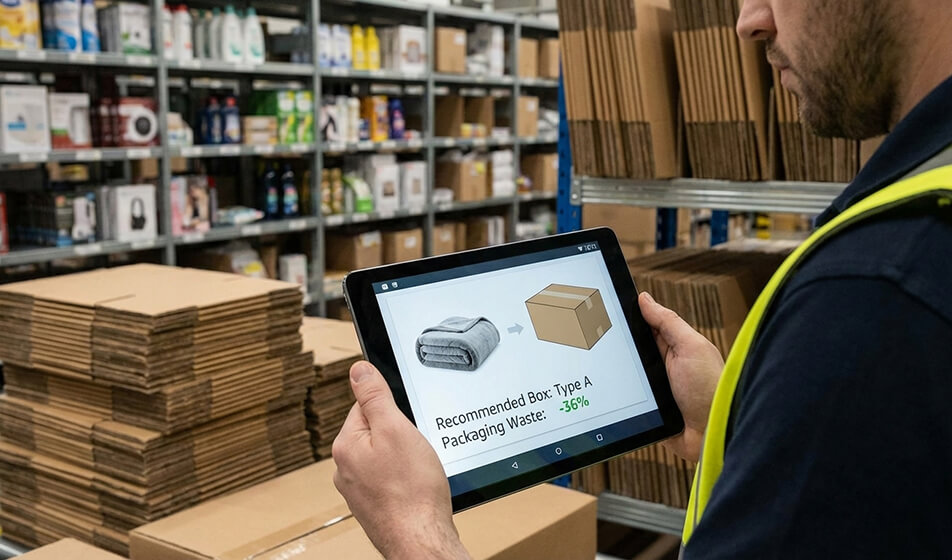
A case in point, as is often the case, comes from Amazon, which, as early as 2024, adopted a system called the Package Decision Engine that combines machine learning, natural language processing, and computer vision to select the most efficient type of packaging for each item to be shipped. Behind cardboard, air cushions, adhesive tape, and envelopes – or behind the decision to ship without an unnecessary box – there is no longer a fixed rule applied in a standardised way, but a dynamic algorithm that, item by item, is based on real data, product images, assessment of critical points, descriptions, performance history, and customer feedback. Built on the Amazon Web Services (AWS) cloud, the AI model can intuit when a more durable product, such as a blanket, does not need protective packaging, or when a potentially fragile item, such as a set of glasses, requires more packaging. Amazon reports an average 36% reduction in packaging weight per shipment. This is what it means to optimise a much broader decision-making system.
Beyond the container: an adaptive and ethical system
Until now, the focus has been first on the product and then on how to protect, contain, present, and transport it. Today, this linear sequence is no longer sufficient. Packaging is increasingly developed within an adaptive and predictive system: whilst designing packaging, materials, regulatory requirements, production needs, logistics performance, user experience, sustainability, and industrial costs are immediately taken into account. This is where AI can step in before the packaging exists as a finished object (even as a prototype), when materials are compared, behaviours are simulated, and the best compromise is sought between protection and lightness, between efficiency and recognisability, and between perceived quality and sustainability, within an industrial ecosystem that can be observed, corrected, and continuously refined.
This evolution is also in line with the Packaging Ethics Charter Foundation, established in 2020 to promote a new culture in the world of packaging, based on principles of responsibility, sustainability, and innovation. It calls for a rethinking of packaging not merely in terms of simple performance, but of the quality of the approach that generates it. It is a crucial distinction. A pack can be attractive or packed with technology and still be wrong. Conversely, even a very simple package can be intelligent if it results from a careful balance between function, material, logistics, communication, and disposal. In this sense, AI can make the design process, step by step, more measurable, more verifiable, and more informed, reducing the gap between idea, simulation, and physical sample.


Where AI meets material, function, and safety
The first place this transformation becomes evident is in primary packaging, i.e., the packaging in direct contact with the product and, for this very reason, the most delicate. Here, packaging is not just about image or recognisability: it is about barriers, compatibility, safety, stability, and preservation. It is the point at which packaging not only presents the contents but also determines their shelf life, integrity, perceived quality, and, in some cases, even their effectiveness. This is why AI in primary packaging matters most when it helps make better decisions about shapes, materials, and performance.
A particularly significant case, precisely because of the product’s delicacy, is the project carried out by MADE, the Italian competence centre for Industry 4.0, together with Fedegari, an Italian company specialising in sterilisation and decontamination systems for the pharmaceutical sector. The project aims to build an AI-based knowledge management platform capable of predicting the behaviour of primary packaging in typical processes of sterile or aseptic drug production. The aim is not simply to improve an existing package, but to find the best possible interaction between process, product, packaging, and regulatory compliance. This is an important step, as it clearly demonstrates that, in packaging, AI does not merely affect the end result but also the system of relationships between process, product, and material that makes it possible. In the pharmaceutical sector, where margins for error and control requirements are particularly stringent, this approach is even more significant: packaging cannot be viewed as a neutral container, but as an active component of process quality.

Whereas the traditional approach involves defining a concept, selecting materials and shapes, creating a prototype, and testing and making corrections, today this process has become more circular: experimentation is more targeted, less scattered, and less costly in terms of time, materials, and errors. Then there is a less obvious, but no less important, issue: the relationship between primary packaging and the consumer. Ease of use, perceived safety, clarity of the relationship between content and container, ergonomics, dosage, and storage: all of this determines the quality and success of a pack. If AI helps to interpret usage data more effectively, compare solutions, correct oversizing or unnecessary rigidity, and verify compliance with regulations, then it is not simply making packaging more efficient, but also better for the consumer.

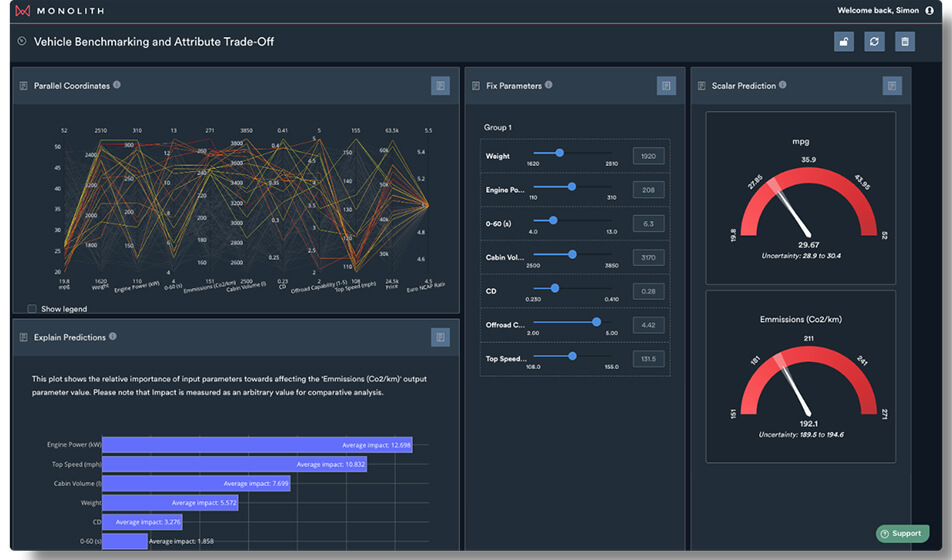
This is what AptarGroup, an international group specialising in dispensing systems, closures and packaging solutions for sectors such as beauty, food, home and pharma, has sought to achieve by adopting Monolith AI, an artificial intelligence platform for predictive engineering analysis. Aptar uses self-learning models to predict the performance of new bottle designs based on variables such as shape, material thickness, liquid viscosity, and fill level. The aim is not only to reduce development times and the number of prototypes, but also to understand in advance how the container will perform in real-world use, including stability, strength, ergonomics, and ease of use.
The digital eye that sees the invisible
However, in secondary packaging, the value of AI becomes even more tangible and easier to measure. Here, everything hinges on the balance of very concrete variables: volume, strength, costs, machinability, distribution, risk of damage, and the opening experience. A box that is too large is not just the wrong box. It means more material to use, more space to fill, more volume to transport, more inefficiency to manage, and, fortunately today, a stronger perception of waste for the recipient.
One key area where AI can provide concrete help is the structural optimisation of packaging. Ranpak, an international group specialising in protective packaging solutions and end-of-line automation, has introduced the DecisionTower platform, which uses AI and computer vision to detect non-compliant boxes, measure empty space inside packages and prevent errors that can lead to machine downtime, incorrect filling or material waste. Here, the algorithm does not merely ‘see’ the box but interprets deviations that affect packaging quality, operational continuity, and the consumption of protective material. According to the company, integrating DecisionTower with the FillPak Trident system can achieve up to a 35% reduction in filling material, precisely because the residual void is more effectively read and managed.
As we saw in the last issue when discussing labels, AI also plays a role in the printing and converting stages of packaging, covering everything from start-up to quality control. It can be decisive in maintaining colour consistency, identifying minor defects, comparing the actual print with the correct reference, and stopping errors before they leave the production line. Traditionally, systems compared the printed sheet with the original PDF. AI has taken a step forward by managing ‘false variations’ (such as vibrations or reflections) that previously generated false alarms. Systems such as those from AVT (Esko) or Bobst use deep learning algorithms to detect defects such as ink splashes, register variations, fading and missing text at speeds exceeding 600 metres per minute. The great advantage of AI is its ability to handle, for example, the complexity of materials. Inspecting metallised, holographic or glossy UV-coated packaging is extremely difficult for standard sensors due to reflections; the models, however, are trained to ignore the reflections and focus solely on structural or graphic defects. This is what ImageTek, a US company that produces printed materials for food packaging, has done, for example. It has worked with the Apple Manufacturing Academy to develop an AI-based computer vision system. Trained using the analysis of thousands of images of compliant and non-compliant packs, this digital ‘super-vision’ has learnt to autonomously recognise anomalies imperceptible to the human eye – particularly after long shifts – and to monitor quality in real time at extremely high speeds, intervening instantly.
But there is no need to look overseas; in Italy, for example, companies such as Antares Vision Group in Brescia and SEA Vision in Pavia have developed neural-network-based inspection systems that are exported worldwide. Antares Vision uses AI to ensure perfect printing and to verify that die-cutting and flap sealing are accurate to the micron, managing the complexity of reflective materials typical of the cosmetics and pharmaceutical sectors. SEA Vision has developed proprietary algorithms for variable print control (such as QR codes or expiry dates) that ‘learn’ to read correctly even on uneven surfaces or beneath plastic films that cause optical distortions. The interesting thing is that these innovations arise from collaborations between universities and industrial districts, both for quality control and for predictive maintenance.
Machines that learn and move the world
Finally, there is tertiary packaging, the least visible to the consumer and often the least discussed: here, too, AI demonstrates one of its most profound impacts across pallets, packages, film, load units, handling, line control, maintenance, and operational continuity. During palletising, AI is used to solve the complex problem of ‘mixed-case palletising’, where collaborative robots stack boxes of varying sizes and weights onto a single pallet, or to instantly inspect whether pallets are correctly wrapped or whether industrial containers are intact. E80 Group, a company based in Viano in the province of Reggio Emilia, uses artificial intelligence to manage automated factories where laser-guided vehicles not only move pallets but also use optimisation algorithms to determine in real time the most efficient route and the arrangement of loads within the warehouses. Antares Vision Group has developed AI that checks that labels on pallets are legible and correctly positioned, preventing coding errors from causing entire loads to be rejected by large-scale retailers.
But perhaps the most advanced example is Nordmeccanica. The Piacenza-based company recently unveiled an AI-managed machine capable of analysing more than 100 production parameters in real time, including materials, film tension, and environmental conditions, and adapting its operation through self-learning algorithms. The heart of the system is software that ‘listens’ and learns from the experience of human operators, so that when a new order is entered, the operator’s digital alter ego draws on a historical database and immediately suggests the optimal settings: Nordmeccanica’s AI acts as a collective memory that preserves the experience of the most expert technicians, making it available to new recruits as well. And so we arrive at the narrative that AI will ultimately take away jobs. In reality, as this overview of applications shows, at the centre, upstream and downstream of these innovations, there is the human being. Production is for the consumer, with their safety and experience firmly in mind. Above all, AI is configured as a support rather than a substitute. It is true: in certain areas, we are moving towards increasingly automated environments. But it is equally true that resources previously devoted to routine, repetitive monitoring and constant error correction are being freed up. The aim is not to eliminate work, but to shift it from managing physical labour and repetition to managing meaning and complexity.