

Eco-design is an increasingly established approach to packaging. We talked about this with three international experts: Sylvia Vitale-Rotta, Founder & CEO of Team Créatif Group; James Pryor, Co-Founder & Creative Director of the Touch agency and Sara Limbo, Associate Professor at the Università Statale di Milano.
Necessary and multidisciplinary, eco-design is an increasingly established approach to packaging. But what does this formula contain, from creative thinking to production and disposal? And how can we prevent the term from becoming an empty buzzword, like so many other declarations of intent? We talked about this with three international experts: Sylvia Vitale-Rotta, Founder & CEO of Team Créatif Group; James Pryor, Co-Founder & Creative Director of the Touch agency; and Sara Limbo, Associate Professor at the Università Statale di Milano.
By Roberta Ragona | On PRINTlovers #87
—
The origin of the term “Eco-design” is to be found in the European Energy-related Products Directive of 2009 (Directive 2009/125/EC). The directive refers to the design of electronic equipment in terms of optimising performance with the same functional quality: a fundamental principle of eco-design also in its current meaning and extended to various fields, including packaging, based on measurable values that can be used as corporate sustainability KPIs. And with the launch of the new tranche of Horizon Europe – the European framework programme for research and innovation – the issue is confirmed as a pressing necessity. We took stock of the state of the art with three professionals with complementary points of view on the sector, from design thinking to scientific research, from communication to the regulatory framework of reference: if there is one field, in fact, that finds its distinctive feature in its multidisciplinary nature, it is precisely that of eco-design.
Eco-design: what questions does it answer, and what are the markets that demand it most?
James Pryor
Our approach to design is based on science. We use ife cycle assessment tools to assess the status quo, measuring factors like carbon footprint, water resources, energy, degradability. We can then use this data to compare our ideas for the future. The brands we work with focus on two areas in particular. The first is materials that are difficult to recycle and for which there is no end-of-life management. An example of this is flexible plastic packaging, such as snack packaging: there is a solid push to find alternatives. The second is products where the packaging is responsible for the majority of the ecological footprint. While for sectors such as the dairy industry the issue is production, in the case of beer it is the packaging, with the creation, distribution and footprint of thick, heavy glass. There is room for optimisation work.
Sylvia Vitale-Rotta
All European countries are focused on the subject. Countries like Germany have been working on it longer, which means more advanced recycling chains and materials research, so the push is on to go further. We are not at the point where consumers stop buying products with non-recyclable packaging, but we are approaching the point where brands will receive financial penalties if they do not demonstrate that they are working on the issue. Changing a production line takes years; the time to plan for these changes through eco-design is now.
Sara Limbo
In recent years there has been a change of speed for companies. Research and academia have taken over the search for solutions to be ready for the market with tested and reliable ready-to-market materials. One of the roles of the eco-designer at this time is also to create parameters for objective comparison of different solutions, which meet the criteria of repeatability of scientific data. When talking about material substitution from the food technologist’s point of view, this also means assessing the impact of these materials on the actual shelf-life of the product.
How do the principles of eco-design apply to packaging, and when can we really talk about eco-innovation?
James Pryor
The most radical redesign examples come from the dry foods sector and from cleaning and cosmetics products. Bag in box packaging formats include a non recyclable bag, dry food products and lots of air, and there is a lot of air between the box and the bag: two layers of packaging and volume that can be removed. We are working in two phases: the first is to remove the air and unnecessary, unrecyclable packaging and use the volumes efficiently; the second is to rethink logistics by eliminating the packaging so that the consumer is not responsible for recycling and brands do not have to deal with buying and processing the packaging. The other example is the cosmetics and hygiene products sector, which incurs unnecessary storage and shipping costs of litres and litres of water. By eliminating water and producing solid or tab products, the possibility of revolutionising packaging with the same product safety is opened up.
Sylvia Vitale-Rotta
Consumers are currently confused; they buy a product thinking it is sustainable, but they do not have transparent information to make a reasoned purchase. As an eco-designer, we have a duty not only to design according to the principles of the circular economy but also to communicate these principles clearly to consumers so that they can make the right choices.
Sara Limbo
The paradox of the past decades is that plastic research has produced so many products that it was long taken for granted that there was a plastic material for every need, with all kinds of barrier properties. Now we are getting back into the game of materials research, recreating that range of options available to companies from new materials and processes. The demand at the regulatory level is to reduce the number of materials to be disposed of: it is a question of reducing the number of variables by creating a supply chain that is advantageous for all, including economically.
Are there any particularly significant examples, from the creative idea to development throughout the supply chain?
James Pryor
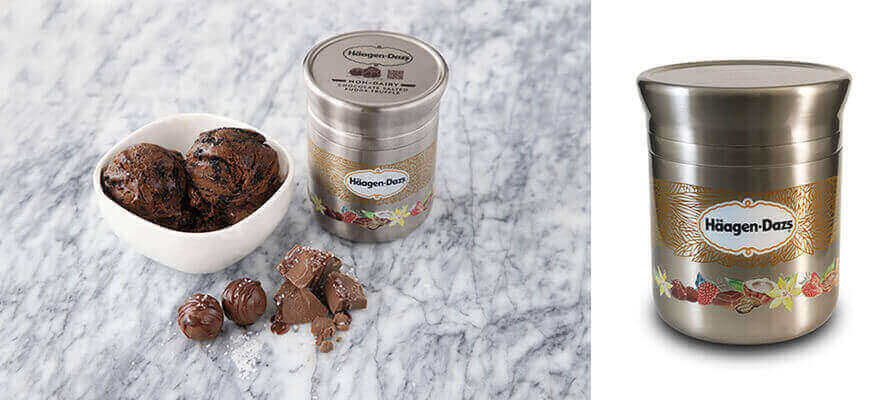
One example is the work we are doing with Loop and Terracycle for several brands, including Haagen-Dazs. We’ve developed a container that can be reused up to a hundred times; the double-walled steel container keeps the ice cream at the right temperature and allows the top layer to melt faster than the bottom, so the ice cream is at the perfect consistency, and the two-layer insulation makes it easy to handle. It has a much smaller ecological footprint than single-use packaging, is 100% recyclable and single-material. It meets the criteria of the circular economy and also works in terms of brand positioning. During the first month of its launch, we had more than 2.4 Billion mentions on social media, and it is the most popular product in Loop’s grocery section in the US.
Sylvia Vitale-Rotta
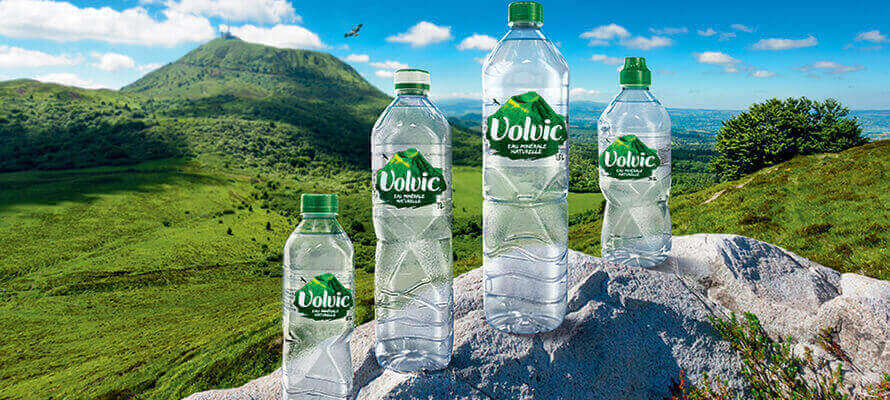
A case history we love is a piece of work we did for Volvic. A study of senior consumers found that the one-and-a-half litre bottle was difficult to handle, causing joint problems. We redesigned it with a more robust, easier-to-use structure that uses less plastic. This success has encouraged Danone to adopt this approach more often in its product design. It’s an example of how design that takes into account everyone’s needs also leads to more sustainable products.
Sara Limbo
We are working on projects that are not yet public with companies who are optimising their packaging solutions for food products, so our role is to help them find new materials and identify critical issues in the supply chain from production to shelf. We are working on existing materials to increase their packaging and preservation performance and collaborating with packaging companies to study and develop recyclable and compostable solutions, thus arriving at simplified materials with an easier end-of-life but still guaranteeing their current quality. If you ask the average consumer what they think is the biggest source of pollution, they will answer plastic. But we have realised over the last year that plastics also meet protection and preservation needs for which suitable alternatives are not yet available in all contexts. Food waste is as serious a problem as plastic disposal, so in my opinion, it will be increasingly important for the work of the eco-designer to be supported by that of communication experts, able to convey the correct information to consumers about materials, their life cycle, the proper disposal and also about the right contexts of use of one or the other, so that they can make correct and informed choices.
The eco-designer is a professional figure who is increasingly in demand. What skills does he/she need to have?
James Pryor
Eco-designers must have the ability to take brand values and consumer desires and turn them into a tangible product, but they must also have a multidisciplinary background. Creativity is combined with knowledge of engineering and material science, logistics, consumer psychology, marketing, legislation, the whole packaging chain and infrastructure. An eco-designer must know the principles of the circular economy and use them creatively.
Sylvia Vitale-Rotta
One of the main differences in the training of eco-designers is their specialisation in specific areas. For many years, structural design was carried out by professionals within packaging companies, who had all the material and process expertise to work independently. It will be more and more common to work in teams with other realities – such as Team Créatif in France or Touch in the UK – because the world of eco-materials is increasingly complicated and the variables to be considered, whether they are the production aspect or studies of consumer habits, will be more and more diversified. We must also address the issue of waste generated by poorly thought-out packaging and logistics. If a product ends up in a landfill before being sold, it pollutes twice, and in the last year, we have had enough examples of the problems linked to logistics to understand that this is another area of work in which the contribution of eco-design will be fundamental.
Sara Limbo
The eco-designer must have different competencies, first of all, in the field of material safety. When it comes to material substitution, it is vital to fill the knowledge gap about the behaviour of materials once they are placed in the real context in which products are to be made, sold and used. In food packaging, this translates into knowledge about food to avoid making sustainable packaging that does not take into account the needs of the product, resulting in food waste. The work of an eco-designer is a team effort, working alongside professionals such as the logistics expert, the technologist and the materials expert. Being aware of these variables makes it possible to control the evolution of quality over time, predict it and build modelling and forecasting mechanisms. It is necessary to use life cycle assessment tools, a quantitative approach that allows us to compare and contrast the impacts generated by one solution numerically with respect to another. We try to train professionals who have these tools, with the prospect of them working in teams with other disciplines such as economics or marketing, enabling them to predict the movements of society.
Environmental regulations: what are the most important ones internationally, and how do they affect the design process?
James Pryor
When working on structural design, the solution must be future-proof: if done well the pack won’t need to be changed for five or ten years. In Europe, there are several specific legislations and taxes on product packaging. We have seen a growth in EPRs, Extended Product Responsibility fees, where the revenue from these fees will be used to fund the infrastructure for disposal, to recycle all materials that enter the system. This perspective impacts many of our customers; we’re working on redesigning packaging and supply chains so that when the laws come into force, they are ready with sustainable products that meet the requirements. The other big paradigm shift is carbon footprint taxation. These changes cut across all markets: in the US, individual states are beginning to introduce packaging specific legislation. France will soon adopt a law to eliminate single-use packaging and have bulk products available in all supermarkets over a certain size. If you design a product that has to live in that world, you have to design it with an awareness of what the future holds.
Sylvia Vitale-Rotta
In addition to these major structural projects that require substantial change, there are many factors to work on. Many of our customers are reducing the inks used on their packaging or switching to vegetable-based inks. Premium packaging is being made with gold or silver foil eco-designed inks which uses less foil because not all markets have the infrastructure to recycle metal foil products. We have also seen a significant reduction in the use of gloss varnishes compared to previous years. These are all actions that can be taken now and go in the direction of regulation, but with a shorter timeframe than systemic changes.
Sara Limbo
The regulatory environment may seem distant from research work, but we have a concrete example in our European context of how regulation and innovation intersect, namely EFSA, the European Food Safety Authority. EFSA is an advisory body where legislation becomes an input for research. At the moment, research in the field of eco-design of food packaging is moving as a consequence of the requests arising from European policies on environmental sustainability. Developing solutions that meet and exceed these demands is an integral part of the eco-designer’s work.
Costs: How much does sustainability affect brands’ costs, and how much does it influence their decisions?
James Pryor
Data shows that efficient use of materials and a supply chain that shortens the distance between production, sale and consumption creates significant savings. The mistake has been to compartmentalise thinking about the cost of packaging, whereas it is a cost that needs to be seen as a whole. When we increase efficiency and decrease waste we become more profitable.. The Ellen MacArthur Foundation, with whom many of our clients work, has calculated that moving to the circular economy means more than $600 billion in savings in energy, resource and technology costs. The mindset of brands has changed; there are many mechanisms in place to facilitate these innovations through tax incentives and financial breaks. They also know that change is inevitable if they don’t want to incur financial penalties in the future. Packaging is seen as an asset, not an unavoidable cost to stay in the market.
– Sylvia Vitale-Rotta
Brands must also consider the risks associated with losing market share. We have already seen examples of changing consumer habits, where seemingly immovable brand loyalty has shifted towards brands perceived as more sustainable. What is now a cost will soon be a legal obligation, and the price of making up for lost time and regaining market share by snatching it from their competitors who have been quicker to adapt will be much higher.
Sara Limbo
Who carries out research in the field of food packaging have the opportunity to see the innovation debate from a different perspective. For companies that have embarked on a research project with the university, this investment is an advantage in terms of communication, knowledge and resources: companies often do not have people within their own ranks who are capable of translating certain ideas into projects, which is what you get when you work with research institutes. It is also a solution for combating greenwashing because it provides data-based solutions that allow consumers to be informed of a technological and economic effort. I am convinced that now is the time for companies to invest in innovation by taking advantage of the possibilities offered by the European Union in terms of funding and resources for innovation through the support of universities and public and private research bodies.
 — James Pryor
Co-Founder & Creative Director di Touch
James has over 20 years of expertise in the product and packaging design industry, delivering major global innovation projects for Unilever, P&G & Nestlé, to name a few. Following several design roles in agencies and in-house for businesses, including Speedo international and 3T, James and Guy joined forces at 1HQ, with James leading the team as technical design lead. In 2008, Guy and James set up Touch, where James leads the agency’s creative output. Recently James has been at the forefront of sustainable design, leading initiatives for brands such as Häagen-Dazs, Highland Spring, and Carlsberg.
 — Sylvia Vitale-Rotta
Founder & CEO Team of Créatif Group
Born in Tanzania of Italian parents and a citizen of the world, Sylvia Vitale-Rotta founded Team Créatif in Paris in 1986 together with Nick Craig. With a presence in 52 countries worldwide – from Brazil to the US via Singapore – Team Créatif Group focuses on branding and packaging design as well as retail design and architecture with Market Value global communication and brand content with Shortlinks for an audience of multinational clients. Sylvia Vitale-Rotta was president of the jury of the Design section of the Cannes Lions in 2009, gave a Ted talk on the theme “Packaging is for People” in 2016, has been a member of the jury of the Red Dot Awards since 2016 and has received many awards for her 30 years of work in design, not least the National Order of Merit of the French Republic.
 — Sara Limbo
Associate Professor, University of Milan
Sara Limbo is an associate professor at the Department of Science for Food, Nutrition and the Environment at the State University of Milan. She is an expert in food packaging and eco-design and an expert in food packaging and conditioning. Her scientific work has always translated into the publication of international journals in the scientific field, and in 2010 she published in collaboration with Luciano Piergiovanni “Food Packaging: Materials, technologies and food quality”, published by Springer.