



Good clean, fair: top of the range organic products stand out because of quality production choices
Good, clean, fair: top of the range organic products stand out because of quality production choices, where the care of the raw materials and the elegance of the product require packaging that matches the contents. We’ve been talking about this with the managers of three top-level Italian agri-food companies: Frantoio Pruneti, Acetaia San Giacomo and Ambrosiae.
by Roberta Ragona | On PRINTlovers#85
In 2018, according to a report by Biobank, Italy achieved 2 million hectares cultivated according to organic farming criteria. With over 80,000 operators in the sector and a turnover of over €6.4 billion (with a large portion of exports), organic food has definitively emerged from the niche consumption sector to become a mass phenomenon.
This widening of the market increases the consumer share, but also generates new communication and packaging challenges since you need to differentiate your product both in quality and in the way it is presented to the public.
Many brands are aiming at communication that conveys the idea of organic food as a product for daily consumption – also to compete better within the large-scale retail trade. But there are Italian agri-food companies for whom organic production is the natural continuation of a long-standing relationship with the land, and a production chain that is the result of a deeply-rooted, local artisan tradition.
Many of these firms are high-end organic, where the care of the raw materials is reflected in the communication and presentation choices. Production choices in the name of excellence and sustainability require packaging that is up to the task, both in terms of quality and the choice of low environmental impact materials and a transparent supply chain. Can organic food detach itself from an imaginary world linked to codified packaging choices that evoke a rustic and uncontaminated world, and adopt the language of luxury in materials and finishes but without compromising on sustainability?
We talked about this with the managers and the owners of three companies that cover different aspects of high-end organic food in Italy: Frantoio Pruneti, a company that has been producing extra-virgin olive oil since the mid-19th century in San Polo in Chianti, in the heart of the Chianti Classico area; Acetaia San Giacomo, whose entire production takes place in Novellara, inside Corte Faragosa, a farmhouse whose origins date back to the mid-15th century; and finally Ambrosiae, a young company in Monsampolo del Tronto that takes its name from Ambrosia, the food of the gods according to the ancient Greeks, a precious food that made anyone who tasted it immortal.
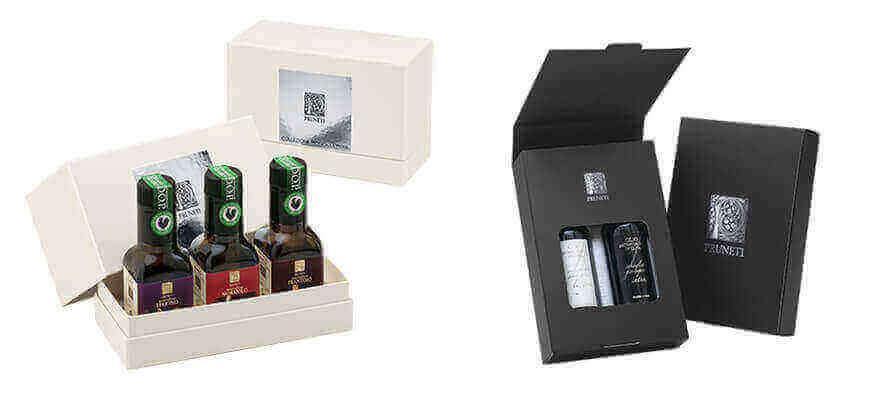
Katy Lapini is talking about the philosophy of the company and the choices of Gionni and Paolo Pruneti. “Even when it comes to packaging, the companies we work with are always local companies, between Florence and the Valdarno Fiorentino area. Through packaging, we try to suggest the product’s features – such as the square bottle for the more characterful monocultivars, and the round one for the fruity, softer ones – but also its intended use and consumption. One example is the bottle of our Olio Nuovo, for which we have chosen a contemporary design. We took advantage of the possibilities offered by innovations in glass processing, using a bottle with a special satin finish that protects the product from light, with a new aesthetic appearance compared to the classic dark bottle. The bottle also suggests how to consume it: the Nuovo is a semi-filtered oil, subject to faster ageing, so it should be consumed fresher, and the light bottle helps to convey this message”.
Finding a balance between the need to keep the organoleptic properties of such a delicate product intact and the need to innovate and evolve with the times is central to the glass packaging for the oil. Recent research carried out by Assovetro, and the University of Pisa and the University of Piemonte Orientale compared samples of extra virgin olive oil bottled in containers made of different materials, including bottles in PET, tin, bag-in-box, and clear glass and green UVAG glass bottles. It showed that dark glass is still the packaging of choice for oils.
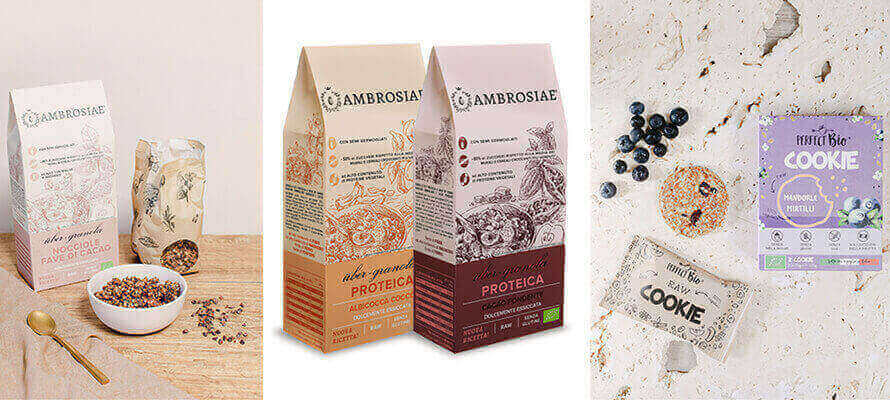
And Ambrosiae – a company that started about six years ago and which is young in terms of its people too – considers research and innovation something that begins with the product and goes as far as the packaging choices. Luca Olivieri, the company’s Operations Manager, comments: “The cardinal principle for the choice is always the safety of the product, so when evaluating which packaging to use, the first criterion was to choose packaging that is resistant to humidity and the entry of oxygen, to guarantee our consumers a healthy food from the first to the last moment of its life. Once this principle has been guaranteed, the other keystone is sustainability, which is why we have preferred paper and cardboard packaging, which of the raw materials available have the least environmental impact. We have worked a lot on design: about ten years ago the organic world was largely made up of small firms for whom communication was not a fundamental aspect; our packaging, inspired by a set of images close to luxury and haute couture – almost a tailor-made dress sewn onto the product – was immediately very eye-catching because of its difference in approach. We are currently testing packaging with compostable films, a very promising material but still a bit early for our type of product because it doesn’t guarantee the requirements for the very best conservation”.
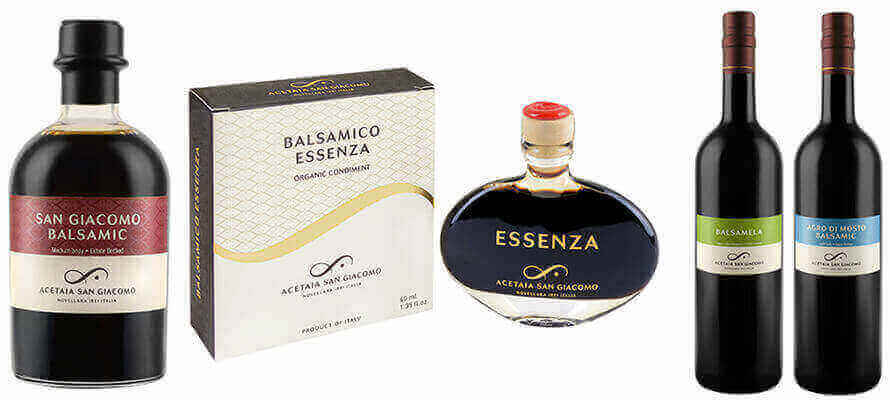
In the case of Acetaia San Giacomo, the philosophy that has guided the packaging choices is careful and rigorous minimalism, the result of detailed research. Andrea Bezzecchi, President of the Traditional Balsamic Vinegar Consortium of Reggio Emilia and owner of the Acetaia, explains. “For us, the important thing is the content: we don’t want to communicate things on the label that aren’t there. The problem in our sector is that there is a highly confusing trend in the opposite direction, so the information on the label is excessive, redundant and not completely necessary for the consumer. People who have to make an assessment are faced with too much irrelevant information that doesn’t help them to make an informed choice. We decided to draw a line and start from a blank page, communicating the essentials, letting the product talk and giving clear information to make an informed choice”.
Acetaia was also the first to implement an anti-counterfeiting tracking system in its packaging to guarantee its product’s quality level and origin. The Balsamic Track system allows, through the unique serial number on each bottle of ABTRE DOP, every single bottle to be traced back: from which barrels the vinegar was taken, when the Control Body tested it, what score it received in tasting, when it was bottled and how many bottles the batch is composed of.
In the decade between 2009 and 2018, the value of organic exports rose from €1 billion to €2.3 billion, 127% up over ten years. Experts predict equally strong growth as an effect of the change in post-pandemic habits, at least judging by the signals coming from the American market. According to data from the Organic Trade Association in the United States, the organic food market reached $50 billion in 2019, a growth of 5% compared to 2018. They’re incredibly encouraging percentages but nothing compared to the surge in the first half of 2020, which seems set to continue in the second half. The consumption and purchase of organic products grew by 50% in the first “stocking-up” period, when families took care to get everything they might need, and remained at a 20% growth rate for all the following months. The United States has always been a crucial place for top-level Italian food, making it all the more a market with which to communicate in new ways. And here packaging comes back into play, whose importance in the e-commerce panorama- where the customer cannot personally interact with the product – cannot be at all underestimated.
“Right now, the most important change is the way we communicate and do our marketing for the foreign market. From a communication that is heavily based on experience, we have enhanced both the e-commerce and online experiences,” says Katy Lapini of Pruneti. “We have set up digital classes, particularly aimed at the US market. This has also meant creating stronger relationships dialoguing much more closely with our import partners, who have helped us to reach – in a new way to in the past – consumer audiences deeply interested in an experience.
For Ambrosiae too, e-commerce has also taken on new importance. “People have certainly become more used to online shopping, and this particular moment has convinced even previously more suspicious sections of the population to get involved with e-commerce. We already have a range of boxes in our shop, so we are also looking into the possibility of developing a subscription box system later on: it’s certainly one less thought for the consumer”.
Another significant change – a direct consequence of altering post-pandemic habits – whose longer-term impact is difficult to predict, will be the change in formats. For top-quality products that often have high-level catering as their primary market, the shift in consumer habits also changes the way chefs’ kitchens are supplied. This is a trend noticed by Acetaia San Giacomo, which has in its offering packages in different formats of 100ml, 250ml and 750ml depending on the various products in its range. “Due to our product’s features, our clientele is 70-80% catering, and we have noticed a change in the most recent period because they have gone back more to buying medium-sized formats. In the last few years, even for the more premium products, we have made bottles in larger sizes for kitchens, because the volumes allowed continuous use, but at the moment kitchens are tending to make more conservative estimates”.
And in the quest for new formats and sustainable materials that can keep consumer confidence together and clearly communicate the quality of top-level products on the Italian agri-food scene, high-end organic packaging is facing up to the challenge.