



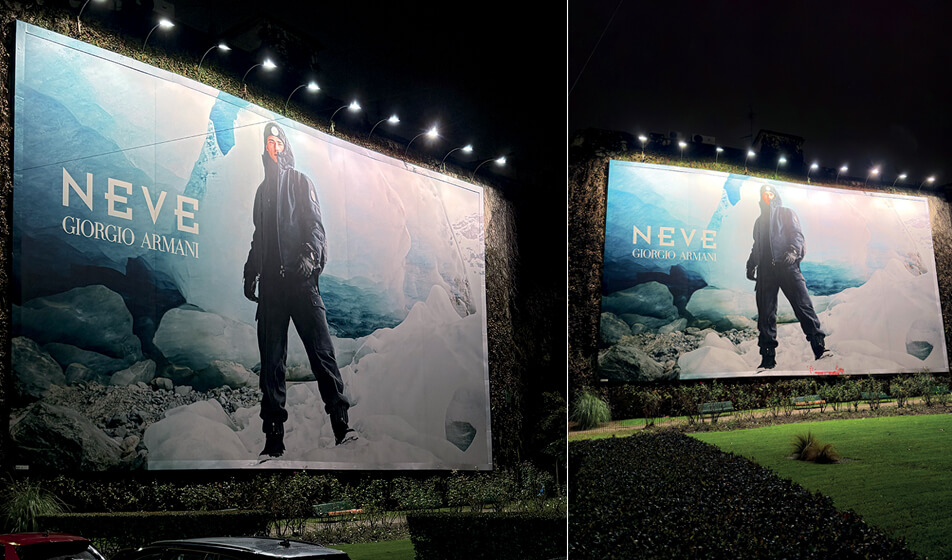
In large-format digital printing, it’s not just about centimetres but about balancing size and precision to ensure quality, flatness, and visual continuity, along with all other aspects of the sector, from file management to finishing, installation, and logistics.
It was 1984 when Sergio Galeotti and Barbara Vitti, a historic Milanese PR company that had been working with Giorgio Armani for four years, had an intuition: to use the same means of advertising detergents, food products, and cars for fashion as well. This is how one of the largest and most iconic billboards was born: the Armani poster in Milan’s Via Broletto.
Initially, there was “a competition of snobbery and bewilderment among fellow designers,” says Tony Di Corcia in his Giorgio Armani. Il re della moda italiana (2019, Cairo Editore): “They said: how awful to advertise fashion with posters, it will end up in supermarkets like ham. They were wrong, aware that they were wrong.” In an interview a few years later, Vitti recalls that “there were giant posters of detergents and cars everywhere, so I thought it could be a very interesting way to present the opening of the numerous Emporio Armani stores throughout Italy. I had the mega-banner made in Cinecittà. The bill was astronomical: 150 million lire. I felt sick at the thought of presenting it to Armani, a man who was very careful with money. But my courage was rewarded: that giant poster was a success.” In fact, within a few days, that billboard became “the Armani mural”, a real landmark that entered into conversations, appointments, and the topography of Milanese life. Like the Fiorucci store in San Babila, from then on everyone said “see you at Armani’s”. Due to its size, an icon was born that, in Giorgio Armani’s corporate slang, is simply called “Broletto”.
But today, being big is no longer enough to be effective: you need the right balance of technology, choice of substrates, finishes, and intended use. We discussed this with two market leaders, Agfa and Canon.
How “big” can you print?
It depends: in large-format digital printing, it’s not just about measurements but about balancing size and precision to ensure quality, flatness, and visual continuity, along with all other aspects of this supply chain, from file management to finishing, from installation to logistics.
When we examine the machines, the available solutions today are roll-to-roll, flatbed, or modular hybrid systems capable of printing on both rigid substrates and rolls, with easy switching between the two.
The most common roll-to-roll widths today range from 1.6 to 3.2 metres, with Canon’s print width reaching up to 3.4 metres. These are the ranges used in most visual communication applications for retail and trade show displays, where, as Giada Brugnaro of Canon told us, “great versatility and exceptional productivity are required for applications on flexible and rigid substrates, from signage to interior décor prints for retail outlets, to packaging.”
But we can go even further: “The limits are the width of the print light and the length of the roll,” explains Massimo Costa of Agfa. “Our technology allows you to print an entire roll with a file 5.2 metres wide and up to 50 metres long. But in practice, for exterior wall coverings, files measuring 5 metres by 10 or 20 are printed. But even more than that.”
Obviously, with flatbed technology, Costa continues, “the limit is the size of the bed, which is normally 3.2 x 2.05 meters or half that size: our solution dedicated to printing displays and exhibition stands can print a maximum size of 3.2 x 1.6 m.” In this category, in addition to the printable size, the available panel sizes, the flatness and strength of the material, and its surface also matter: a panel that is too large tends to bend, warp, or become unmanageable during finishing. The real limitation is often ergonomic rather than technological. This is why manufacturers invest heavily in substrate-handling technologies, combining suction systems for holding with air cushions and balls for moving materials. “At Canon,” explains Brugnaro, “we use a combination of patented airflow technology to hold different types of substrates in place with minimal masking, and an optional feature that creates an air cushion to easily position heavy or difficult-to-handle substrates, reducing the risk of damage and ensuring uniform registration.” But what happens when using porous, corrugated, or very light materials? “On materials that are not perfectly flat, such as wood,” recalls Costa of Agfa, “it becomes necessary to increase the printing distance between the printhead carriage and the substrate. Here, technology becomes essential in order not to lose too much quality, and therefore it is necessary to have an automatic recalibration system for the print ‘focus’, i.e., to recalculate the trajectory that the print drop must take at a different firing height. The final result can be very different between different manufacturers of printing systems.”
When the plane or reel is no longer sufficient, and it becomes necessary to go beyond the light of the machine, the only option is to join multiple panels. This situation applies to soft signage or fabric printing, which involve lightweight, reusable, and easily transportable applications such as event backdrops, backlit walls, and modular displays. In these cases, the graphics are divided into coordinated modules that must fit together seamlessly once installed. This requires invisible joints, calculations of allowances and thermal expansion, and ensuring colour consistency between panels.

Resolution: a question of balance
Because we’re used to working with standard formats and print sizes, we naturally think in terms of more pixels and higher quality. However, in large-format printing, we think in metres rather than centimetres. The relationship between file resolution, size, and viewing distance is not as simple as we often assume. The larger the image, the farther away you view it, and as the distance increases, the perception of detail decreases. In other words, 20 ppi viewed from 10 metres away can appear just as sharp as 300 ppi viewed from 30 centimetres away.
Finding the right balance between size, resolution, distance, and file size is key. A 6 x 3 metre outdoor poster should not exceed 100-120 ppi at 1:1 scale; an indoor panel visible from two metres might need 150-200 ppi; and a backlit window display or lightbox viewed up close can reach 250 ppi. Going beyond these levels offers no real benefit, as the human eye cannot perceive any additional detail. Canon suggests calculating resolution based on viewing distance (like 100-150 dpi for outdoor) and using RIP for controlled scaling.
Today’s machine manufacturers have developed print engines that use interpolation and screening algorithms to translate resolution into perceived visual detail, rather than relying solely on numerical density. The latest technologies focus on drop frequencies and dithering patterns—techniques that reduce graphic artifacts—that intelligently compensate for the lack of pixels in the file; as a result, a 600 x 600 dpi print can appear sharper than a nominal 1200 x 1200 dpi print if the drop control, black point, and substrate calibration are properly adjusted.
A common mistake is to set the file to its actual size at 300 dpi “to be on the safe side,” but this makes a 5 x 2 m print unnecessarily heavy. The best practice is to work at a reduced scale, with a resolution proportional to the scale itself. For example, 1:10 at 300 dpi is equivalent to 30 dpi at actual scale: more than enough for most outdoor applications. In short, you have to think like Georges Seurat rather than Canaletto.

Inks and varnishes are part of the project
If file preparation is so crucial for print quality, then materials, especially inks, are even more vital. Even in large format, it is the substrate and its finish that determine colour rendering, visual effect, and durability. Each substrate, whether rigid or flexible, glossy or absorbent, responds differently, which is why the choice of ink also becomes a key part of the project.
UV technologies are used for rigid materials such as Forex, acrylic, cardboard, aluminium, wood, and glass. Canon, for example, uses UVgel inks that combine the advantages of UV ink with latex, ensuring flexibility and adhesion across a wide range of substrates. The inks are first fixed and then polymerized using low-temperature LEDs, offering precision, saturated colours, and minimal penetration, especially in porous or rough materials such as corrugated cardboard or cardstock. These materials are becoming popular due to their lightness and sustainability, but require careful management of absorption. The result is an instantly dry, odourless print with a uniform, velvety finish, ideal for interior design, decorative, or backlit applications. Agfa also inevitably uses UV in combination with other hardware solutions to print on materials that are “more critical than others, including glass, which must be printed on the correct side and sometimes requires primers. Then there is tin-printing, where success depends on the top coating and on testing different types of inks. For stretch textiles, tension control is crucial, which involves adjusting the fabric tension as the reel is unwound and rewound.”
White deserves a separate discussion because it plays a key background role in many applications, not just transparent ones. When used as a colour itself, it must be opaque; when used as a background for other colours, it must ensure full compatibility and uniform coverage. The approaches differ, though. Both Canon and Agfa print white, but Agfa’s method is more closely tied to the desired yield: their machines can be configured to print white and colour in the required order in a single pass, and they can also optimize printhead firing frequency to achieve the required opacity. This prevents any speed loss because printing occurs in-line and consumption is optimized. Canon, on the other hand, aims to “offer a covering, stable, and highly productive white with the same reliability as colour inks. Thanks to its gel formulation and UV LED polymerization, white behaves like a standard colour, providing consistent coverage on dark, translucent, or transparent materials, with high-impact visual results. It dries instantly, avoiding smudging and reducing wait times.”
In terms of finishing, large-format printing offers innovative solutions by combining size with digital finishing technology, creating classic visual and tactile effects, as well as 3D effects, which are especially important in flatbed printing. At Agfa, “with different application modes, you can achieve full-table or spot finishing, combining matte areas with glossy or varnished areas. In addition, it is possible to produce 3D prints by adding white and colour channels with a final varnish, if needed. In this case, we can achieve thicknesses of up to 50-52 mm, including rigid materials with matte, glossy, textured, or varnished finishes.” Canon also enables you to achieve matte and gloss effects in the same pass “without changing inks or substrates: the difference between the finishes is determined by the moment of polymerization,” even webfed, while on flatbeds, “practically any material from 0.2 mm to 4.5-5 cm can be printed, depending on the model, and multiple textured finishes can be achieved with material effects that resemble leather, wood, or fabric.”

Safety and sustainability
While large-format technology now enables printing on nearly anything, the real difference today lies in how safe and sustainable that printing is. It is not only used for outdoor communication but increasingly for interior design in showrooms, offices, hotels, schools, hospitals, and environments where air, light, and materials directly come into contact with people. Usually, compliance with Greenguard Gold standards is required—a certification issued by UL (Environment) indicating the product emits very low levels of volatile organic compounds (VOCs) and other chemicals—and IKEA Compliant, which shows that the product meets the environmental and health standards set by IKEA for furniture and interior decor materials, standards that are also adopted outside the company. These standards “are often required for trade shows, display stands, and generally by those who need to offer a green product,” Costa explains. Canon is also Greenguard Gold certified and is dedicated to protecting the environment by optimizing ink and electricity use.
Then there is the issue of fire resistance, which is vital for soft signage and indoor setups. Fabrics used for backdrops, walls, and stands must meet standards such as EN 13501 or classes B1 and M1 under European and French regulations. This involves ensuring the material does not spread flames and, in the event of a fire, does not emit toxic substances. This requirement is increasingly common in museums, shopping centres, airports, and historic buildings undergoing renovation, where the installation is temporary but still requires certification as permanent.
“Canon materials for soft signage, banners, and displays,” Brugnaro points out, “cover a range of applications such as tensioned fabrics, PVC-free, paper, and film. They are designed to ensure fire safety without sacrificing print quality and dimensional stability, and they all come with certification that guarantees transparency and compliance for every project.”
Finally, there is operational sustainability, which is less visible but more tangible: machines that turn on and off automatically, autonomous maintenance systems, ink recovery, recyclable cartridges, and reduced warm-up times in line with Energy Star and EPEAT Gold standards. These details have become a permanent part of supply specifications and, in the environmental and production balance sheet, carry as much weight as aesthetic appeal, communication impact, and production quality.