

The artificial-ness of generative AI and the practical applications for print
Have you tried one of the growing number of generative AI technologies? You may have tried Bard, Google Duet, ChatCPT or one that uses the Open.AI infrastructure. Microsoft, AWS, and other platforms also have solutions. They use algorithms to respond to prompts, leveraging available data pools to provide responses. They can be taught to respond to almost anything that can be broken down into steps. They can analyze and synthesize to provide what appears to be added information. And they can make mistakes. Are you ready?
By Pat McGrew – McGrewGroup, Inc. and Ryan McAbee – PixelDot Consulting | On PRINTlovers 101
What Do We Know about AI?
No topic is quite divisive in the technology community as Artificial Intelligence (AI). Depending on which ideological side you are on, it is either the ruin of the human race or ushers in the next Renaissance. Some supercomputers already perform calculations in one second that would take a person more than thirty-one billion years, according to analysis from the Indiana University. This level of computational power has advanced science and improved everyday conveniences like our smartphone ecosystems.
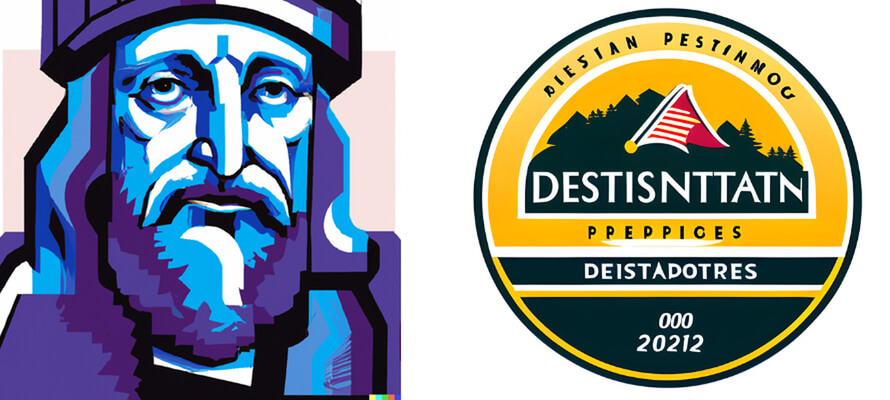
When AI-driven machines can perform functions that we see as human-like, such as perception, learning, creativity, and reasoning, we take notice. It is why the new generative AI platforms like Open AI’s ChatGPT and Google Bard have captured our collective imagination and caused trepidation for their potentially disruptive possibilities. Generative AI creates content based on inputs or prompts, mostly in the form of natural language requests. For instance, you can tell Open AI’s Dall-E 2 to create a detailed Johannes Gutenberg portrait in the style of Andy Warhol and it might generate something like the following image.
As with most technologies, the result will likely fall somewhere between the hype and destined-for-doom extremes, finding adoption and practical applications. Which brings us to the real question. Are there any practical applications for the printing industry today? If so, are there any concerns?
The Practical Applications for Print
Generative AI is for creating content. It can create text and images, transcribe and translate audio, and write computer code. What better way to understand how this technology can be used in the printing industry than by asking ChatGPT? The top six use cases, according to ChatGPT, are:
- customer support
- design assistance
- order customization
- prepress troubleshooting
- product recommendations
- order tracking/updates.

A recent Gartner Group survey of 2,500 executives found that the top reason for using this type of AI was to enhance customer experience/retention. Implementation of AI-driven chatbots is seen as one way to improve the customer experience. They can create a more natural dialog than most scripted interactive bots, with the expectation that customers will find it more pleasing.
AI chatbots and the other top use cases are not turn-key at this point. Each use case requires knowledge of how to use APIs to tap into the AI engine and additional coding to train or fine-tune the model to give the best and most appropriate responses. As a simple test, we added a chatbot to The Print University website powered by ChatGPT, indexed and embedded the content of the website to refine the model, and asked a few simple questions. The results were interesting but not always accurate.
When asked, “What is The Print University?” the chatbot provided a generally acceptable response stating it offers training videos for the printing industry. When asked about the cost, the responses were inaccurate and seemed fabricated from other data sources. One response compared it to the price of the content platform WordPress. Another response suggested the modules ranged in price from $49 to $599, although it has never been sold individually. Perhaps that is why ChatGPT gave this disclaimer to the first question about how it could be used in the printing industry: “It’s important to note that while ChatGPT can automate customer interactions, there may be instances where human intervention is necessary. Printing companies should ensure that customers have the option to escalate conversations to a human representative whenever needed. Additionally, regular training and updating the model’s knowledge base will help improve its performance and accuracy over time.”
The results can be useful and impressive with the right prompts and the proper AI engineering. Image generation, like the portrait above, is an example of how good the technology can be for specific applications. Print service providers, without any in-house IT expertise, can use the technology to assist in writing content and product descriptions for their websites. Prepress and in-house creative designers could also use image generation for quick sketches to explain concepts to clients and possibly augment the final design process, although some are limited on the file types that can be downloaded. These uses, however, come with caveats.
Current Limitations of Generative AI
While impressive, generative AI still has limitations. Asking for long-form written content often creates repetition, particularly if the topic is a niche to start. In some cases, observed more with image generation, the text copy of the image may be random filler text. The following example was generated by Canva’s text-to-image feature to create a logo for a fictitious company called “Destination Properties.” The result falls short of a professional designer and contains nonsensical text.
In other instances, the output produced by generative AI is simply wrong. Image generators often struggle with creating accurate facial features. Similarly, text generation can result in completely fabricated information like the pricing information previously mentioned. The takeaway is that a person still needs to review, edit, and curate any content created by this technology.
Industry Vendors are using Generative AI
While ChatGPT, Bard, the new Google Duet Workspace, and so many others have captured media attention, many of the vendors in the print industry began looking at their options to use AI and its adjacent technology, machine learning (ML) years ago. Imposition solution providers leveraged the combination of AI and ML techniques to present the most viable imposition schemes based on specifications like waste reduction or minimizing changeovers. Other tools began to incorporate AI/ML techniques to speed the development of color profiles, prepress workflow profiles, and workflow rules development for automation solutions. You may have been using AI solutions and never known because many vendors kept it behind the wall as their secret sauce.
The use of AI in solution infrastructures is growing in both print and customer communications. If you watch the webinar and product demonstration announcements, you will find some interesting integrations of OpenAI’s ChatGPT, Significant-Gravitas’s AutoGPT, and even integrations of the new GrammarlyGO features. Of course, much of the AI infusion is also under the covers and not exposed in the marketing.
Look at the announcements from MessagePoint, Crawford Technologies, and Quadient to see how generative AI is enhancing their solutions. MessagePoint put the work in to leverage ChatGPT to improve MARCIE-generated customer communications and to provide guidance to ensure that the tone of the messages matches the organization’s intent. The team at Crawford Technologies leveraged AI techniques to create SmartSetup 2.0 with AutoSense to eliminate scripts from document indexing and other processes through the use of smart templates. The Quadient team leveraged AI for their AI-based template migration solution designed to optimize legacy content before migration and produce new templates fit for modern workflows.
The Risks of Generative AI
- Regulatory changes and litigation
Generative AI systems are trained on massive data sets which may have contained copyrighted and trademarked work, including intellectual property (IP). Litigation already filed, including class action suits, will start to shape the laws, regulations, and rules going forward. Until that point, it will be a litigious road ahead. - Lack of transparency
The use of user-submitted information by the companies and platforms behind generative AI offerings is not well understood. Some companies, like Samsung, have issued memos instructing employees to not use company devices and avoid inputting any company-related details over concerns of leaking company IP into the public domain. - Timeliness of data
Some solutions, like ChatGPT, use data sets to train their AI that are not current and so asking it to generate anything that happened in the past couple of years is problematic. - Accuracy
The systems can produce nonsensical – up to completely fabricated – results.
As with any innovative technology, the disruption forces change. Change in how we support and communicate with clients. Changes in the way we work. Changes to the rules and regulations. Until the technology and legal framework further matures, cautious optimism is the best approach. As an industry, we need to understand how these technologies work and are progressing. It has the possibility to displace, replace, and augment activities in print production. Not today but sooner than we like to admit.