

Chamaleonic faithfully safeguards essential oils and raw materials until they are transformed into perfumes
Chamaleonic. Similar to silver, white gold and platinum. Easily available. It can becused extremely easily as a printing substrate, and become wrapped by colours, words and logos. It is bold in welcoming unusual colour effects. It is casual in its raw state as technical material, about to become a luxury product. It faithfully safeguards essential oils and raw materials until they are transformed into perfumes.
By Marilde Motta | On PRINT #80
Aluminium comes out into the open and it becomes trendy. We are shown this process by Thierry de Baschmakoff, Jérôme Dinand and Chafik Gasmi, three well-known international designers who have used aluminium to make their projects iconic.
Thierry de Baschmak off
off
What do you think if I say aluminium?
If you say aluminium, the first thing I see are the red hills of Estérel, in the south of France. In primary school in Grasse, I learnt that Estérel’s red colour was due to bauxite, a rock that contains mineral masses used to produce aluminium. This was how I first came into contact with the material. Later on, I experienced the colour, the smooth surface and the lightness of the finished material. For a long time, I associated aluminium to technology, mainly because of sports accessories.
Have you ever used aluminium in your packaging for perfumes?
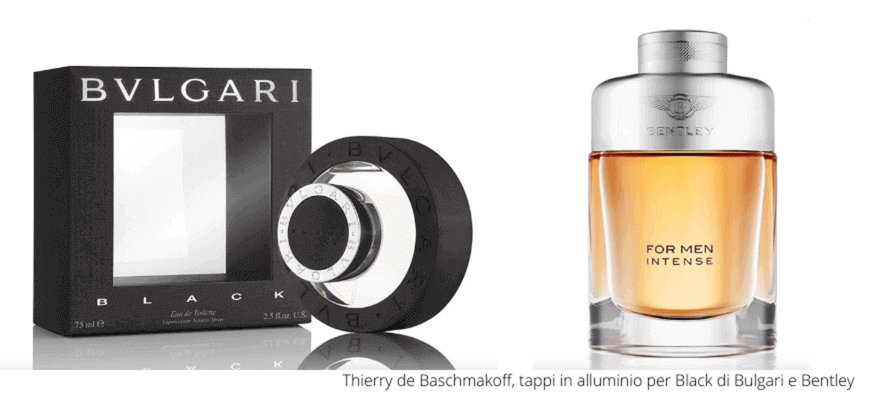
I started working with aluminium very early on. I love this material. I apply different techniques to it: either stamping or turnery. I have even experimented with die-casting. One of my aluminium projects was a refillable container with hollow parts for Van Cleef & Arpels, which I imagine would still be challenging to make today. I chose aluminium for a very sophisticated travel set when I launched “The Different Company”. It was made by turning a solid piece of aluminium, and at the time the result was notable. Naturally, the cost was very high because of the production, but thanks to the material the result was unique. Since then I’ve used it for many other projects. One was the Bulgari fragrance Black, a project linked to the Bulgari Aluminium watches for which I used the material in combination with rubber. More recently, I’ve used it for Carven latches, for the metal element in the Bentley fragrance, and many others.
Do you think that the expressive and creative qualities of aluminium have been fully explored?
Part of what makes aluminium so interesting is that the colour and surface finishings are infinite. It is unique to the touch, and so is its weight. It is the only material that can be entirely recycled as it is, which will be a key aspect in the future. We can certainly explore this material further. Sometimes the production process is complicated, but looking for new ways of interpreting the material will help us advance. A new process, such as 3D printing, would be an alternative for prototyping and making complex forms with aluminium.
Aluminium loves cold, could it become a cool material?
Aluminium loves both the cold and heat, and has a good resistance to high temperatures. It has been used in the chemical industry for a long time. In the perfume industry, the well known “estagnon” (cylindrical container), which is produced in Grasse and protects essential oils and perfumes from heat and light, is made of aluminium. Aluminium and perfumes are a good combination, and design needs to explore this further. Its only fault is its low resistance to impact in the stamping process. Regardless, it’s a smooth material to the touch.
Thierry de Baschmakoff
Thierry was born in Grasse, the French city with a high density of perfumes and “nez”, but his origins are scattered across Europe. He trained as an engineer at the prestigious Les Arts et Métiers school, and has always had a desire to carve his own unique path in design. His ten-year collaboration with Bulgari has been a very intense experience, but over four decades of work Thierry has been responsible for over 6000 other projects in a wide range of fields and using a wide range of material and techniques. A common thread? At least two: luxury and lasting beauty.
Jérôme Din and
and
What do you think if I say aluminium?
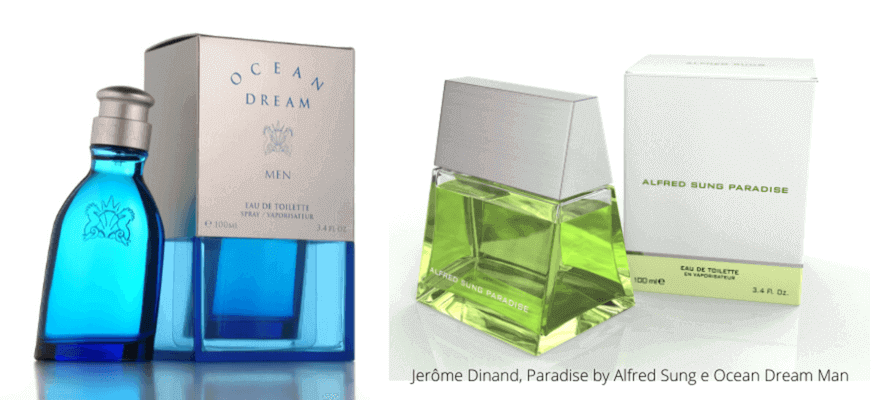
Aluminium suggests lightness and essential simplicity, as well as sophistication once it’s coloured. Its natural colour, which reminds us of silver and tin, amplifies and opens up an endless world of colours and finishing through anodizing. Its scientific name “AI-13” could be the name of a robot in a sci-fi film and is perfectly suited for this surprising metal. An important point to make, considering the challenges of sustainability, is that aluminium – like glass – can be recycled endlessly. The question is: how can we make sure we’re recycling as close to 100% of it as possible? It’s not only a matter of the consumer’s individual responsibility: the industry, designers, and brands must develop products where aluminium, plastic and glass can be easily separated. A good example is the plastic-free lipstick case re-proposed by Reboul-Aptar. In this search for sustainability, we must also be careful about the conditions of extraction of bauxite, which contains aluminium, the red mud residues, solvents, and anodizing baths.
Have you ever used aluminium in your packaging for perfumes?
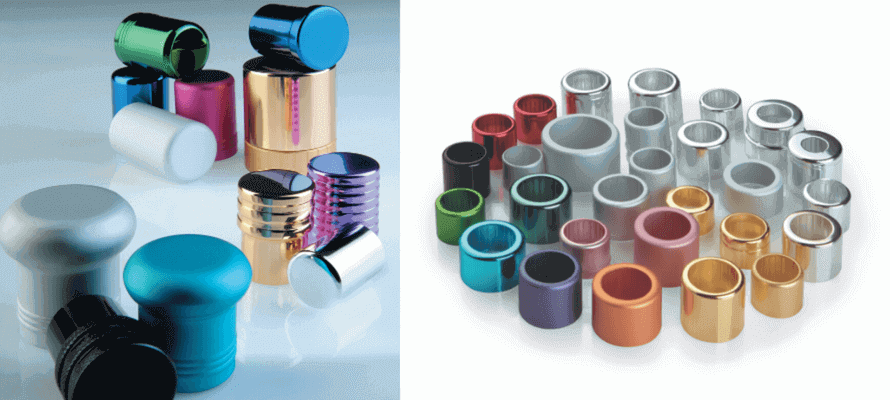
We have always used aluminium for the packaging of fragrances. It plays a key role in closing mechanism, sprays, and structures. During the second half of the 20th century, aluminium gradually replaced all other metals used for seals, screw-on caps, and metal casings. It has also been used to decorate glass bottlenecks for perfumes that are poured (hiding the grinding), and to secure the adaptor for spray bottles of aftershave. As an affordable material with excellent dimensional tolerance, it has become the perfect material for pumps (actuator, seaming, threaded parts). Pumps, latches and rings are often personalised with engraving, embossing and particular closing and opening mechanisms. We have noticed an increasing use of magnets in aluminium latches. Another important sector is aluminium cans, aerosols or natural sprays for hair products, deodorants, perfumes and home fragrances. The most cost-effective and sustainable solution for latches is the aluminium triangle, which is also used for testers in perfume labs. It is a simple, plastic-free individual piece of aluminium, which is adapted to the pump or the bottleneck thanks to its triangular shape.
Do you think that the expressive and creative qualities of aluminium have been fully explored?
There are continuous innovations in the drawing of aluminium to achieve sophisticated shapes and reliefs. This attracts markets which have previously only used plastic or zamac. The same can be said of colours and textures: anodizing labs are constantly proposing new finishings, textures and colour hues. There are new developments in silk-screen printing and lacquer, while etching makes incredibly fine details possible, and laser cutting and engraving play a key role in the success of aluminium today. Once we reach the limits of the complexity of shapes, we can move onto metallizing plastic in a vacuum, or varnishing it, even though this changes the look and depth of colours. Zamac is a high-quality alternative thanks to its weight and malleability. However, it is more expensive, less precise in dimensional tolerance, and is produced more slowly.
Aluminium loves cold, could it become a cool material?
Aluminium is fresh rather than cold and suddenly, when it’s heated in the anodizing process, it becomes orange and red, with a satin, velvet, or rubber feel to the touch. In terms of it being a “cool” material, the perfume industry was on the first ones to use it for packaging, in order to keep the product fresh and to protect from light and air. Essential oils such as lavender and geranium were stored in containers called estagnon (originally made of copper or tin and then aluminium). The qualities of aluminium and technological progress have made it the material for our drinks. However, cans need to be internally treated so that they don’t interfere with the liquids. Some fizzy drinks and aromatic ingredients can be corrosive even for aluminium.
Jérôme Dinand
Jérôme Dinand studied literature, philosophy and Japanese before starting his career as packaging designer in 1983. Art and illustration are his main sources of inspiration and he believes that innovation, visual appeal and the quality of materials are crucial for the success of packaging. After a dozen years in his family’s agency, he started his own, “J.D.”, in 1995. He’s designed over 100 perfume bottles in 15 countries, collaborating with major cosmetic groups and famous stylists. Jérôme Dinand teaches courses at Jian Qiao University in Shangai on perfumes and packaging. His son Jules, after having studied architecture, now collaborates with “J.D.”.
Chafik Gasmi
What do you think if I say aluminium?
When I think of aluminium, I imagine lightness, I can hear a plane flying. I find it particularly graceful because of the infinite possibilities it offers, rather than because of its colour. I love black or white, grey is quite literally in the middle. Aluminium is a noble material because of its infinite creative potential. For example, liquefied aluminium is absolutely splendid. The multiplicity, quality and versatility of the shapes that aluminium can take are more interesting than its colour.
Have you ever used aluminium in your packaging for perfumes?
At the beginning of my career, when I was art director at Sephora, I used aluminium for the packaging of some essential oils and floral essences. My main preoccupation is to reinvent design and question contemporary design in order to progress. At the moment, it’s very difficult to make a better bottle than the aluminium one. It’s the definitive material. It is so complete that it has become the standard. Aluminium is light, it can be compressed and folded, it can be recycled and it is durable. My wife started Demain, a completely natural, organic and eco-responsible cosmetic brand, so for us aluminium was the obvious choice for packaging. We printed on it and coloured it directly. We played with its reflecting quality. Lightness is a theme that guides me. Combined with a strong emotional experience, such as the one offered by luxury, I am certain there are still plenty of possibilities to explore.
Do you think that the expressive and creative qualities of aluminium have been fully explored?
This material is a double-edged sword. On one hand its carbon footprint is appalling, on the other hand once it’s produced there are no extra costs. We could use the existing quantities and not produce any more. To answer your question, I really think we can further explore aluminium in design, but also in engineering and architecture. We used to want to build durable buildings, so they were heavy and inflexible. This causes problems when they become obsolete and need to be knocked down. Today we need to build in a lighter and more flexible way, because we live in an ever-changing world. We need to build in a light and flexible way to last over time. Aluminium is used for finishings, but it will soon be used for construction. Ultra-lightness and ultra-performance are key concepts in our age and aluminium intrinsically has the qualities to become a material used in infrastructure.
Aluminium loves cold, could it become a cool material?
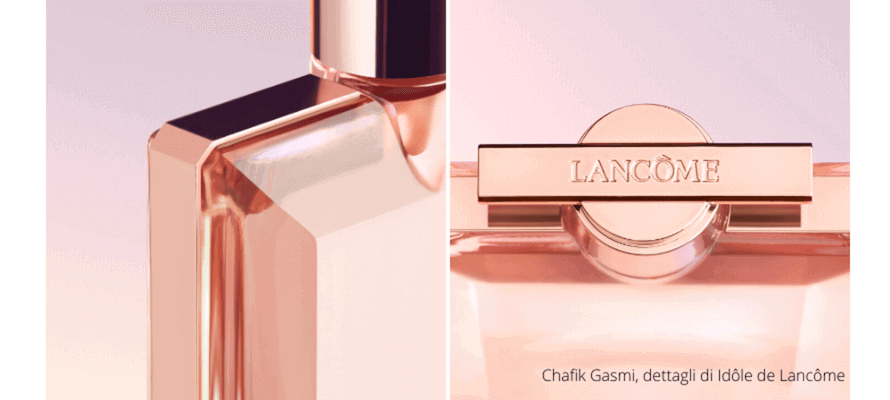
It can be both. The extremely positive impact aluminium has on perfume bottles is that it protects the perfume from the light, keeping it intact for a long time. However, its opacity also has a negative side: it’s not transparent. Colour and transparency are key values in the perfume industry. I think skincare products and creams are associated to metal jewellery (and therefore have opaque aluminium packaging), while perfume is associated with diamonds (and therefore a brilliant transparency). Obviously, these are conventions which can be overthrown to favour radical metal over transparent glass. Now that we’re talking about it, I can imagine an Idôle bottle entirely made of aluminium. It makes sense to me.
Chafik Gasmi
Chafik Gasmi is an architect and industrial designer. His start was in furniture design, where he obtained important recognition. He then worked as Sephora’s art director, also contributing to the conceptual development of the brand. He then worked for big brands such as Kenzo, Bulgari, Baccarat, Fendi Casa, Lancôme, but also important commissions such as the Museum of Modern Art of the Arabic World in Algiers. His work in design and architecture has grown over time and his studio has opened offices in Morocco and Portugal. His latest design is the Idôle perfume bottle, which received the Luxe Award Forme prize.