


What makes a fashion accessory truly “valuable”?
What makes a fashion accessory truly ‘valuable’? In the past, it was mainly the raw material, leather, processed and decorated using traditional methods. But new approaches – including ethical ones – and new technologies have created a market for valuable accessories on PVC and synthetic leather, thanks to digital printing allied with artistic expression. Many exclusive collections originate this way: we talked about it with Canon Italia, Bagful, Pattern Thetravellovebag, ScarletVirgo and the illustrators Andrea Tarella and Debora “Senz’h” Giudici.
By Roberta Ragona | On PRINTlovers 95
Bagful
The project began as a creative exercise 100% Made In Venice in support of Disability Friendly, an awareness and inclusion activity on the issues of motor and cognitive disabilities rooted in the Veneto region and carried out by Famiglie e Abilità and Oltre Il Muro.
JJamapa
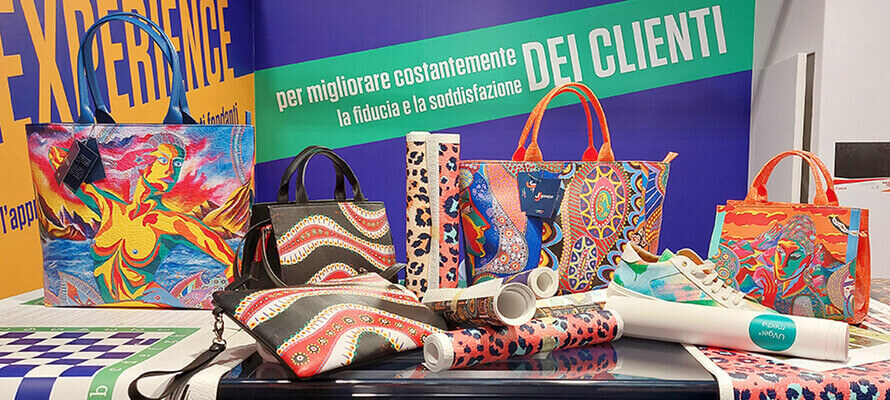
The collection of bags made using Canon printing technologies reproduces the enamel works of Pasquale Nasta, artist and teacher at the Accademia delle Belle Arti in Bologna. The first run of about 500 pieces was marketed as a capsule collection in the Selfridges department store.
ScarletVirgo
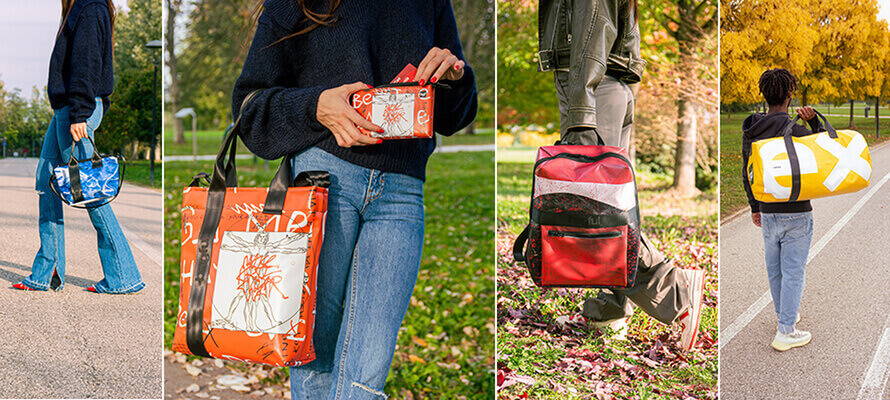
The brand was founded in 2010 by Céline Claire and Federico Gastaldi. Both from artistic backgrounds, their research in the field of leather goods initially began with work on recovering textile and warehouse surpluses before focusing on handcrafted accessories made from high-resistance materials and artists’ fabrics designed exclusively for ScarletVirgo.
Pattern Thetravellovebag
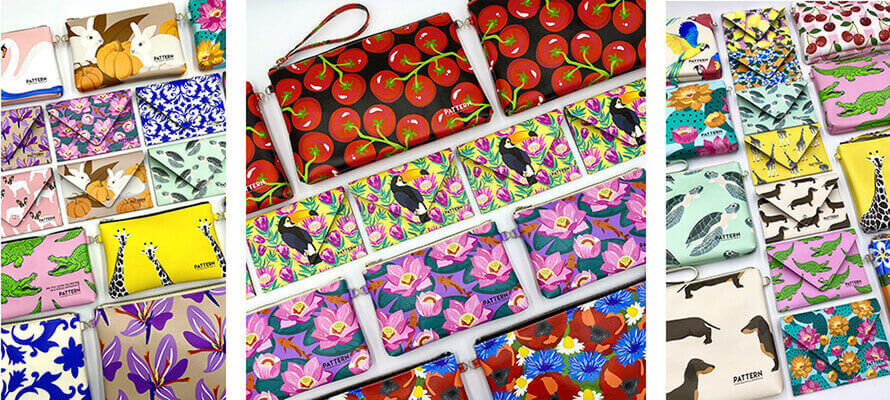
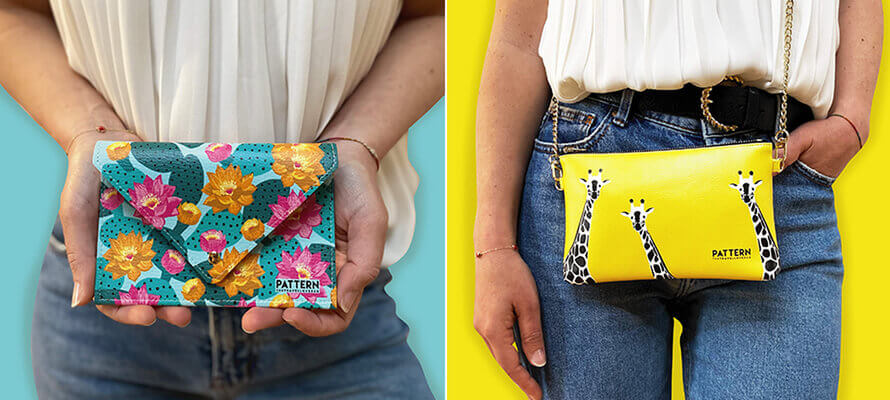
The brand started in Bergamo in 2016. All their bags are made of synthetic leather decorated with travel-related subjects, represented through patterns depicting significant elements of the place. Each bag is accompanied by a short story evoking memories of the journey.
Tod’s Isetan Capsule Collection
The Tod’s capsule collection, designed by Andrea Tarella, was created for the Isetan Shinjuku shopping centre in Tokyo: a collection exclusively linked to that place and that can only be purchased there.
Technology and language are moving at two different speeds: “leather goods” in the sense of “the set of objects, especially those that constitute clothing accessories, such as handbags, belts, gloves, various ornaments” nowadays no longer means talking only about processed natural leather. PVC and synthetic leather from natural or synthetic fabrics coated with polymers are the substrate for sophisticated capsule collections entrusted to the flair of illustrators and visual artists, realised by exploiting the potential of direct digital printing.
But what factors have contributed to this change? First of all, the public’s conception, as Matteo Dittadi, head of design at Smartmix, the agency behind the Bagful project, points out: “The way materials are considered has changed: on the part of the consumer there is greater attention to design and innovation even with materials that are not ‘noble’ to begin with. The added value comes from design, printing and finishing. The increased accessibility of online printing tools, which has made skills once limited to the industrial graphic arts sector available to a pool of creative people, has played a major role in this change. The boundary between industrial and homemade production has become more a question of print runs than technology.”
Paolo Organo, Product Business Developer LFG&TDS at Canon Italia, explains how the refinement of materials and printing technologies triggers mutual feedback of innovation: “For Canon, the Jjamapa project started two years ago in collaboration with a synthetic leather manufacturer. Starting with one of its substrates – a polyurethane compound coated on cotton and polyester warp – we arrived at a range of five materials with different finishes optimised for Colorado UVgel printing devices. The materials have passed the benchmark abrasion tests for the market, showing significant resistance to degradation without the need to apply a protective layer on top, with considerable savings in terms of production time. At the moment, they are designed for the main market of direct digital printing – fashion in the first place – but we will soon extend the range to the furniture/contract sector, with an eye on new opportunities in the maritime sector.”
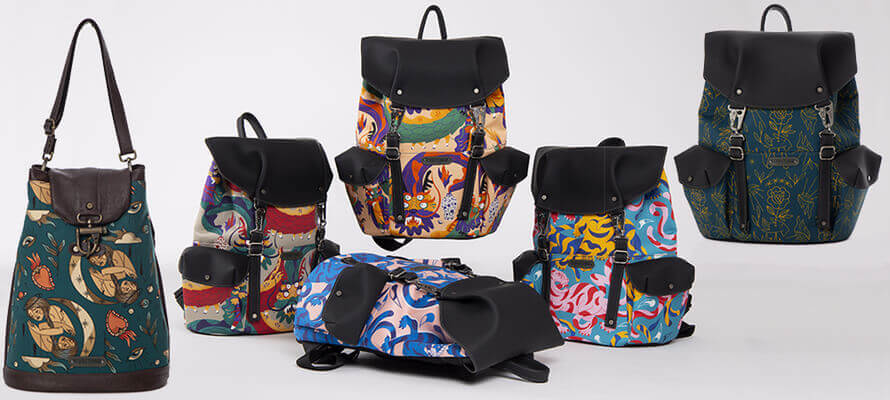
And it is precisely the materials made for upholstery in the maritime and automotive sectors that are the raw material from which the ScarletVirgo bags are made, in combination with the artist’s fabrics made especially for the brand. Founders Céline Claire and Federico Gastaldi explain: “We work with Italian-produced synthetic leather made for use in the automotive and nautical sectors: it has very high resistance characteristics and is treated to be water-repellent and fireproof. For printing, we rely on GLM Printing Textile, a trusted laboratory in the Como area. We tend to use the word ‘sustainable’ with caution, but the footprint of our products is a key consideration in our work. We try to make bags and accessories that last over time, and the artist collaborations we have been carrying out for more than five years are also part of the same philosophy. When the product has something to say, customers tend to take more care of it and make their purchases last.”
Sigilli Ancestrali also demonstrates this, ScarletVirgo’s most recent capsule collection, designed by the illustrator Debora Giudici, aka Senz’h: “When it comes to an illustrated collection, the harmony between artist and project is fundamental, because, unlike a more classic communication work, the possibility of exploring personal themes and languages translates into an expressive force that people respond to. And to faithfully transpose this force from the boards to the products, it is important to find the right materials, as Federico Gastaldi comments: “We produce test runs on which to study the combinations of fabric and synthetic leather, also playing with the size of the patterns: it is a fundamental moment to find the right support, depending on the glossiness of the material, texture and ink absorption.”
But when it comes to artist’s accessories, what plays in favour of using digital printing over the other available techniques? Paolo Organo answers: “The possibility of exact colour repetition and the final output is one of the strengths of digital printing. This means you can reduce single runs that simplify stock management – especially when we are talking about artist’s accessories, which normally involve the production of a limited number of pieces available for a limited time – while maintaining a constant and unchanged level of product quality.”

This is also confirmed by Michela Fiorendi, founder of Pattern Thetravelloeabag: ‘Digital printing allows us not to have to stock too much. Being able to replicate the subjects while maintaining the same aesthetic yield – in particular, thanks to the possibility of piazzato fabric printing – is essential. With piazzato, the subjects are printed so that they appear at a specific point on the packaging. In this way, the positioning of the elements is constant from one bag to the next, something we could not have achieved with roll printing”.
But who is the target audience for the artist’s accessories? Matteo Dittadi paints quite a precise portrait: “The audience for these products is mainly adults, particularly between the ages of 25 and 55: adults and young adults, whose taste is less tied to fashions and more in search of products that meet both their practical needs and a personal taste that has had plenty of time to refine itself.”
And when it comes to personalisation, the age range widens further, as Michela Fiorendi points out: “It is often daughters gifting their mothers or grandmothers a personalised bag, or mothers giving themselves a present. Often the subject is pets, for whom the printed item is no longer just an accessory but becomes part of their emotional world of affection. This type of audience is willing to wait because the object’s value is not immediate gratification but a purchase that will stay with them for years. Often customers order objects linked to a specific journey before leaving for that destination: they feel part of a community of people who share a certain type of sensitivity.”
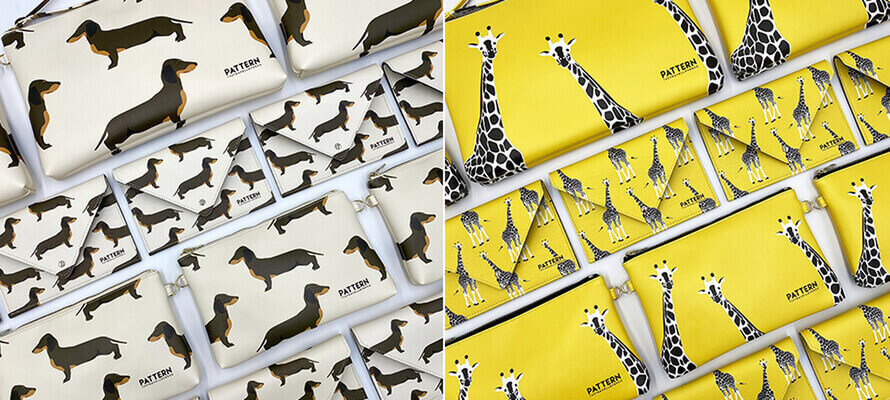
It is, therefore, often a type of purchase linked to the value aspect of one’s consumption, which translates into design thinking, as Céline Claire explains: “The customisation of products is part of the very idea of objects that must last: in our shop, Casa Madre, it is possible to customise products by choosing from the entire sample book of shapes, colours, combinations and fabrics, and we offer almost unlimited after-sales service. Bags can have a very long life by using durable synthetic leathers and replacing fabric parts. This respect for the material starts at the design stage, thinking about how to cut the pieces to minimise waste, also with a view to a circular economy. Currently, we are working on the reuse of textile material from both linings and scraps with an association that works with craftswomen in Morocco to create a line of carpets.”
In artists’ accessories, the relationship between the products and the context is often thought of as a total experience, and the dialogue with the setting begins with the materials. Indeed, Paolo Organo emphasises how synthetic leather is a material increasingly used indoors for its sound-absorbing capacities and aesthetic impact, strengthening the link between setting and product.
For Tod’s capsule collection for the Isetan pop-up store with Andrea Tarella’s illustrations, finding a common language between the products and the site-specific setting was a key point: “The project with Tod’s began to celebrate the anniversary of the Holly Bag, one of the brand’s most iconic bags. The idea was to retrace the bag’s history through an animated video made with illustrations in a surreal style. The work continued for the Isetan Shinjuku space, the particularity of which is that all pop-up stores must propose a collection exclusively linked to that location and only purchasable there. Since it was a summer collection, I came up with a series of designs that were then reproduced on the accessories, and in the shop fitting in a single image applied in wrap-around to the whole stand, right up to the windows and communication.”
Tarella finds that this dialogue between one medium and another is also reflected in the design concept: “There is a lot of modular thinking when working on similar projects. For me, it is an integral part of the workflow: I design each element by hand, separately, so that it can be broken down on the various media without losing expressive power.”
And with the advent of sustainable neo-materials, more and more manufacturers of high-end accessories are offering printed collections made of vegan leather from vegetable raw materials: a blank canvas for artists made from mushrooms, pineapple, apple peels and cactus fibres. Who knows? It might also become a source of inspiration.