

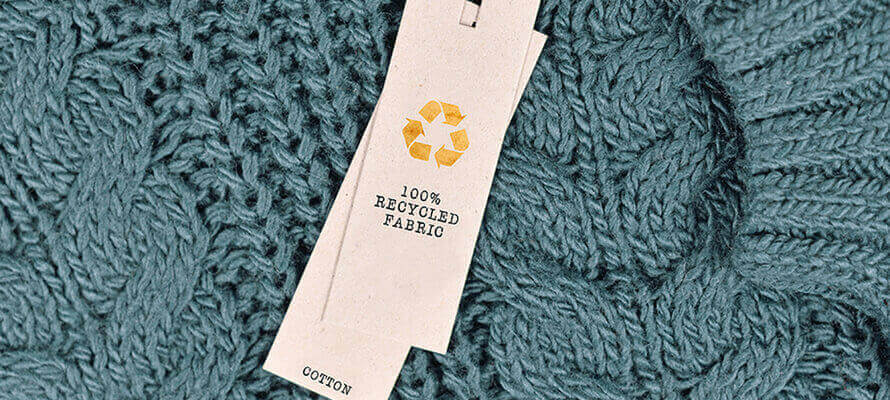
Textile waste, if not sent to landfills, can give rise to unprecedented creative opportunities
…new circular products are being born. The biggest unspoken issue in this industry is the management of waste, most of which still ends up in landfills. And yet, as well as reducing environmental impact, they can give rise to unprecedented creative opportunities.
By Caterina Pucci
In November 2021, Fortune magazine published an article with the memorable title, “Patagonia doesn’t use the word sustainability. I’ll tell you why.” It was written by Beth Thoren, Environmental Action & Initiatives Director of the famous outwear brand for EMEA. In this open letter, Thoren does a “mea culpa”, explaining that Patagonia knows it is part of the problem and that “offsetting emissions for a fee does not erase our environmental impact and will not save us in the long run”. Turning to other brands, she urges them to “stop the empty talk”, denouncing the lack of clarity in the fashion world “which fuels greenwashing and blocks concrete action”. After all, consumers have become familiar with the circular economy concept and expect words to be matched by deeds. Awareness-raising slogans are no longer enough; concrete action must be taken to ensure the traceability of the supply chain. One of the main problems concerns textile waste, which is mainly disposed of in landfills. The latest regulations on reducing environmental impact are trying to involve textile companies more actively. Italy seems to be on the right track in this respect. In anticipation of European provisions, as of 1 January 2022, Legislative Decree no. 116/2020 (art.2) has directly involved manufacturers, importers, and distributors in recycling and recovery activities. We talked about this with Roberto Cozzi, Chairman of the FOR Textile Management Committee, Fulvio Alvisi, President of the Italian Textile Designers Association and Professor of Textile Design at the Aldo Galli Academy of Fine Arts, Giuseppe Bosio, Textile Expert, Andrea Moretti, Tutto Tessile sales manager, and Ivan Balossi, owner of Sublylife.
It’s the second-hand economy, baby
According to the NGO Ecos, 80% of the environmental impact of a garment is determined at the design stage. And according to an estimate by the Ellen MacArthur Foundation, the value of textile waste incinerated or sent to landfills every year, without being subjected to recycling and recovery operations, amounts to €100 billion. In recent years, brands and designers have expressed their interest in adopting a more sustainable approach. Now, however, is the time to go further, investing in more efficient use of products and promoting the reuse of materials generated in the post-consumer phase, i.e. at the end of the useful life of a garment or accessory. For Fulvio Alvisi, we are witnessing the emergence of new business models inspired by the second-hand economy, which consists of the recovery and sale of used goods. Compared to 2016, the number of people buying second-hand clothes has increased by 64%. Young people, in particular, are leading this battle: 46% of Gen Z buy from second-hand shops and say they prefer these products to those from the fast fashion market. The phenomenon has also gradually conquered the world of luxury, as demonstrated by the success of Vestiaire Collective or Tradesy. Not only are we buying more second-hand goods, we are also borrowing them. This is shown by the URBN group (owner of the Urban Outfitters, Free People and Anthropologie brands), whose clothing rental business, Nuuly, has grown sixfold in two years, reaching a value of $47 million last year.
More creative reuse thanks to digital
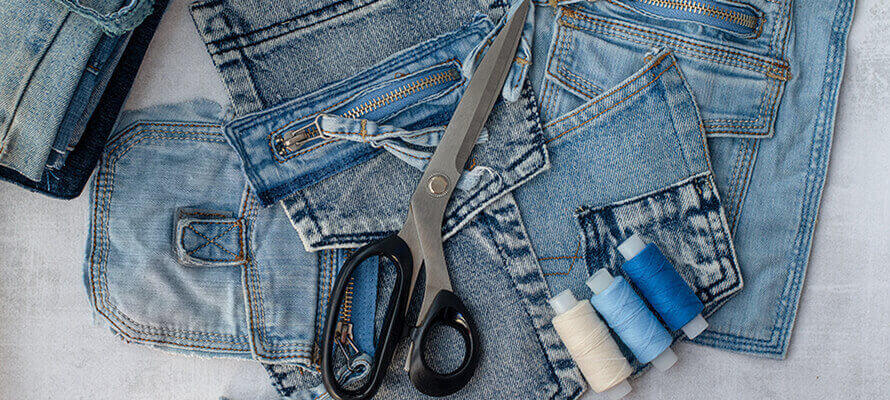
Upcycling is a term coined in 1994 by German engineer Reiner Pilz. In an interview, he said he considered recycling down-cycling, whereas we really need upcycling, whereby old products are given more value, not less. It can be rephrased as ‘creative reuse’ because it aims to transform objects into new products of higher quality, real or perceived. Digital printing has proven to be an excellent ally in valorising used clothing. The combination of technological innovation and sustainable creativity has led to the creation of “Upcycling: fashion becomes sustainable with Epson”, a project involving Epson, the Accademia di Belle Arti Aldo Galli – part of the IED Network – in Como and greenchic, the top Italian marketplace for pre-loved fashion. The aim is to rewrite the destiny of used clothes. Under the supervision of Fulvio Alvisi, coordinator of the Master’s degree in Textile: Design, Innovation, Sustainability at the Accademia, nine students selected some garments made available by greenchic and transformed them into new, unique and original pieces, thanks to the customisation possibilities offered by digital printing. To print the garments, they used an Epson SureColor SC-F100 dye-sublimation printer. The outfits were then subjected to a poll in which the greenchic community voted for their favourite model. The winning outfit will serve as inspiration for a creation by the greenchic designers.
The paths of reuse are endless
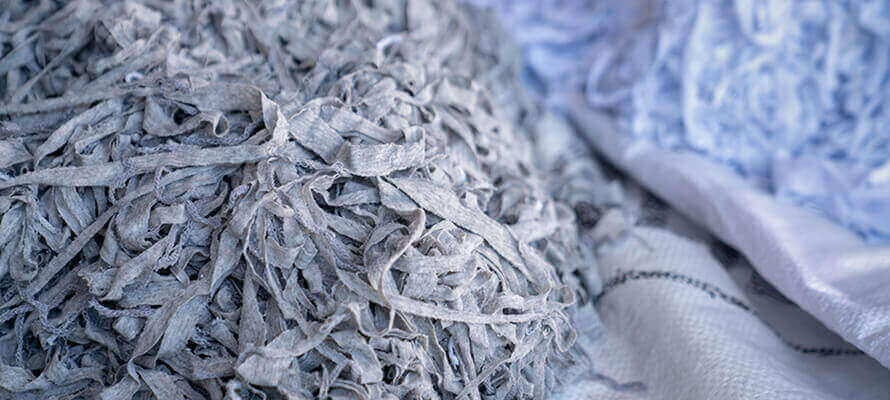
The General Assembly of FESPA Italia 2022 (the federation of screen printing and digital printing industry trade associations) was held in Milan on 18 February. Giuseppe Bosio, Textile Expert, explained that it is only by learning to recognise the different fibres that it is possible to identify the most appropriate printing and finishing technologies for a specific type of application. In addition to investing in the development of less polluting solutions and innovative materials, we need to think about the life cycle of products to understand how the supply chain works and how post-consumer recycling and recovery operations work. To begin with, disposal varies depending on whether the garment is post-consumer (worn and arrived at the end of its life), pre-consumer (never used), pieces (i.e. strips of fabric without hems or finishing) or what is known as “off-cuts”, i.e. residual parts of a piece. Tutto Tessile is a company based in Bergamo that deals precisely with the recovery of this last category of textile waste. The materials collected can be either natural or synthetic fibres and come from factories, cotton mills, knitting mills, and garment manufacturing companies. “Before proceeding with collection by container, each company undergoes an internal audit to assess its suitability,” explains Andrea Moretti. Once recovered, the waste undergoes a sorting phase, separating the different fibres. It is not sure that all of them can be recycled or recovered. Their ‘reusability’ depends on many variables, such as the quality of the fibres from which they are made, the pigments with which they have been printed and the chemical and mechanical treatments they have undergone. “Mixed fibres are more difficult to recover,” Moretti continues, “because each of the materials from which they are made has a different end of life. The presence of metal eyelets (mainly used in visual communication to make banners or hangers, ed.), which are practically impossible to remove, makes recovery and disposal operations difficult.” In the case of Tutto Tessile, about 80% of the processed material is recycled, i.e. it leaves the plant in the form of raw material and is sent to wadding and spinning mills that use it again in production.
Greener advertising printing is possible
Some scraps are being used in visual communication, where textiles have been the mainstay for some ten years now. Sublylife of Bergamo specialises in sublimation printing on various materials, from technical textiles to rigid materials such as sheet metal and glass. It has recently launched a parallel project, Green Print, to make advertising printing more sustainable and compostable. Printing on natural materials such as bamboo, hemp and viscose, Green Print is patenting a digital printing process compatible with fabrics made from compostable materials. The application areas for this technology range from interior to outdoor, from exhibition design to retail. The applications printed to date have passed all ecotoxicity tests and have been certified as compostable in accordance with UNI EN 13432. “The advantage for companies that decide to use our service is that after removal, the material will be sent to dedicated composting plants; after 90 days, it is transformed into compost rich in nutrients and phytotoxic according to OECD guideline 208, which can also be used as a fertiliser in organic crops,” explains Ivan Balossi. “From the results of the tests we conducted, it seems that printing on compostable materials does not compromise the functional aesthetic characteristics typical of virgin fabric. The colour rendering is comparable to that obtained with sublimation printing. The same applies to resistance to external agents: even after 4 or 5 months, the samples have not lost their brilliance. If we want to talk about the circular economy, the beauty of our technology is that it allows us to create an open cycle and not a closed one because, from the fertiliser, a new plant will be born and therefore new life.”
The importance of certification
Reducing the textile industry’s impact is only possible by adopting a comprehensive approach to sustainability, which considers not only environmental factors but also social and governance ones. According to Roberto Cozzi, it is now customary for those wishing to work in the fashion industry to comply with a number of international standards that brands have signed up to or even drawn up. The most common are the Global Organic Textile Standard (GOTS) and the Global Recycle Standard (GRS). As the name suggests, the former refers to organic textile fibres such as wool, silk and cotton; the latter to products containing recycled materials. “They are highly sought after because they control the entire supply chain, i.e. they apply to all companies involved, both at the production and commercial level. This means that even an importer, who only sells the finished product, must be certified if they want to work with most of the brands on the market.” For viscose, a semi-artificial fibre obtained from the processing of wood cellulose, one of the most sought-after certifications is FSC, specific to the forestry sector and wood products. However, this does not guarantee control of the entire supply chain but only the buying and selling stages. This is one of the reasons why projects such as Canopy, a Canadian non-profit organisation, have been set up to make the cellulose supply chain more sustainable. There are also lists of prohibited substances that all suppliers must sign to work in a given segment. The main one is the RSL (Restricted Substances List), which can be supplemented by other more specific lists such as the ZDHC MRSL, reserved for the manufacturing sector. Each brand can also create its own PRSL, an ad hoc list indicating which processes and practices its partners must comply with. If, until recently, this seemed to superficially affect the world of interior decoration, this is no longer the case. “Using the analyses and data provided by our members, we are developing new sheets dedicated to the world of furniture, upholstery and curtains,” continues Cozzi. “There are a number of specific requirements for these industries, such as a fabric’s ability to resist abrasion or its tendency to pilling. The needs of certain countries must also be taken into account. In the United States and Japan, fire resistance is essential for fabrics intended for public spaces, such as cinemas and theatres, and private ones. Adherence to a certification mark such as FOR Textile, which has been committed to enhancing the textile tradition of the Como district for over twenty years, can help companies not only to make their commitment to sustainability measurable but also to approach markets whose characteristics are not fully known, and which are constantly being updated.
Journey to the heart of certification
Global Organic Textile Standard (GOTS) guarantees that organic textiles are produced in accordance with stringent environmental and social criteria. It applies to all stages of the production chain, from harvesting the fibres through the subsequent manufacturing stages to the labelling of the finished product. It has gained wide recognition, resulting in certification accepted in all major markets.
Global Recycle Standard (GRS) applies to companies that manufacture and/or sell semi-finished or finished products containing recycled materials. This also applies to the entire production chain, including the logistics phase.
OEKO-TEX Standard 100 was established in 1992 and guarantees that textile products (raw materials, semi-finished products, finished garments) do not contain or release any substances that are harmful to health. The tests for toxic substances are based on the product’s intended use, so the more intensively a product has to come into contact with the skin, the higher the requirements are. The most restrictive product class is number 1, which covers not only products (underwear, sleepwear, crib/bedding) but also textile toys for infants and children up to three years of age.
European Flax guarantees the quality of European flax fibre by certifying the 100% European origin of the flax fibre (from France, Belgium and Holland) and the respect for the environment according to three fundamental principles: zero irrigation, zero GMO, zero waste.
Responsible Wool Standard (RWS), promoted by Textile Exchange, is one of the most critical international non-profit organisations for responsible and sustainable development in the textile sector. It provides for the issue of a third-party audited environmental statement that ensures that the wool comes from responsibly managed farms that meet stringent animal welfare and environmental impact reduction criteria and maintain traceability throughout the production process. The certification covers the entire production chain from livestock farms to textile manufacturing.
Canopy is a Canadian non-profit organisation that seeks to make the supply chain for cellulose (from which viscose is made) more sustainable.
Better Cotton Initiative is a global non-profit organisation that aims to transform the cotton supply chain by combating negative impacts in the cultivation and processing phases, safeguarding and implementing the economic development of operators in the chain.
FOR Textile is a product and process certification system that derives from the evolution of the Seri.Co brand, whose origins date back to 2001. It is issued by TÜV Rheinland Italia, an independent certification body, against a specific mandate given by Centro Tessile Serico Sostenibile, owner and manager of the brand.
*The title quotes a song by the Italian singer-songwriter Fabrizio De Andrè