

Returnable glass and “manifesto-labels”. Levico Acqua involves its customers in the conscious use of the most precious commodity
Returnable glass, “manifesto-labels” and commitment to the local area: Levico Acqua, a Società Benefit since 2020 and B Corp, involves its customers this way in the conscious use of the most precious commodity. Mauro Franzoni, at the helm of the Emmetre holding company that bottles and sells the Trentino water known for its virtues since the 17th century, and Bruno Stucchi, the designer responsible for the “print advertising”, tell us all about it.
By Achille Perego | on PRINTlovers #91
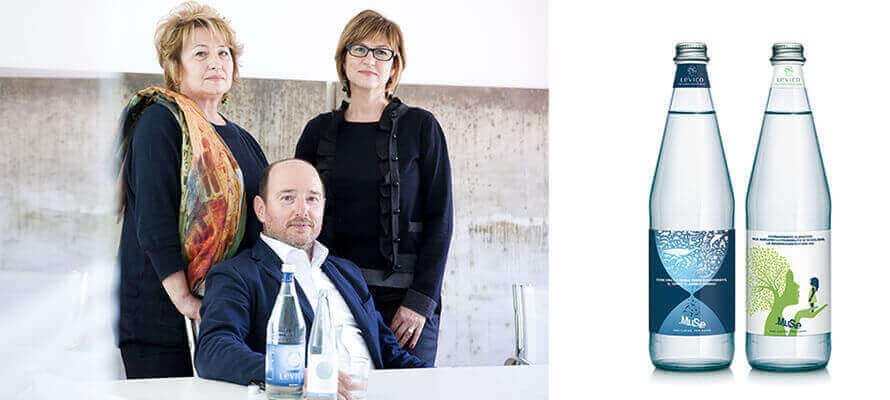
From their origins as textile entrepreneurs (the Franzoni Filati Group) to mineral waters, cosmetics and organic foods, the Franzoni family’s journey has seen some “pieces” (such as textiles and NaturaSì) sold off over the years, but it has always been characterised by what is now fashionable to call sustainability. Mauro Franzoni – born in 1959; his sisters Margherita and Marilì also work in the companies that make up the Emmetre holding: Levico Acque, Keminova, Ghiacciopuro – leads the group and prefers to call it the “responsibility” of the entrepreneur. Even when (and perhaps above all) the company concerns a public good, as in the case of Levico, which bottles the light mineral water of the same name that has been known, like the spa, since 1600. It is a responsibility, together with the winning trait of sustainability, which concerns not only the content (mineral water) but also the container, from never having betrayed the use of glass bottles to the particularity of the labels, which over the years have become a real ‘manifesto’. We, like other producers of bottled water,” says Franzoni, president of Levico Acque, “are using a common good, giving it a little extra value and making it a private business. But this asset is not the result of our work; it already exists, so respecting it and having respect for the environment that surrounds us, the community where we operate, and society, in general, should be a duty for us and for those who do our job”. This is one of the reasons why, since 2005, when the Franzoni family bought the historic Levico Acque through Emmetre, they have embarked on the path of sustainability and circularity that has led them to becoming a pioneer in Italy and in the Trentino region of investments that respect the environment and the community, becoming a Società Benefit in 2020.
Levico has always chosen to bottle its water in glass, and, as Franzoni says, has never thought of switching to plastic, “Even though mineral water in glass bottles, with the return, narrows the distribution channels, which for us consist of 70% in the private sector, 10% in supermarkets and local and organic shops and 20% in Horeca. And while we are thinking of projects that in the future could make glass bottled water sustainable for large-scale retailers as well, we are achieving significant economic results with the goal of 30 million bottles sold this year, intending to reach 45 million in the next few years”.
The pandemic has also impacted Italians’ preference for mineral water in glass: “Both the increase in household consumption and the spread of the culture of environmental sustainability have had an effect,” continues Franzoni. “In addition, glass was and remains the most suitable container for maintaining mineral water quality over time, especially Levico water. So we have invested not only in the classic return of glass but also in the return of aluminium caps, as well as in our poster labels through which we communicate the culture of eco-sustainability”.
Levico Acque, in recent years, has also launched a series of partnerships in the Trentino region to promote its message of entrepreneurial responsibility. This includes the 2016 agreement with Arte Sella – the nature trail with land artworks created using natural elements in Borgo Valsugana not far from Levico Terme – and with MUSE, the Science Museum in Trento, of which Levico has been a founding partner since 2013, to inform about how everyone’s contribution is fundamental to building a circular and regenerative economy.
The particular and innovative approach to the labels on mineral water bottles is also part of this process. True to the company’s values, the idea is to use labels to communicate the company’s eco-sustainable philosophy. The project began with the bottles for catering, then those sold on the shelves and door-to-door, involving designer Bruno Stucchi. Educated by the great names in Italian design, long-time global creative director of S&H/Young&Rubicam Brands and creative director of Landor’s Italian office, Stucchi has worked in New York, London, Sydney, Paris and Milan, where his independent studio Dinamomilano is currently based. Founded in 2010, it specialises in Design and Integrated Communication for clients and entities with a high cultural and ethical profile, from art and music to responsible lifestyle.
“The idea,” explains Stucchi, “originated in 2017 from a stimulus by Mauro Franzoni, who wanted bottles to become vehicles for messages of values and responsibility. From a communication and design point of view, they are real “print advertising”, provocative, ironic, even controversial, but with the added dimension of being an object of “packaging design” that must work on a bottle, not only as communication then but also as an aesthetic result”.
Particularly significant, adds Succhi, “are those designed in the catering line for Arte Sella and recently for MUSE, with messages and images that are more sophisticated than those of the litre reference for door-to-door use, deliberately with a familiar and “pop” tone. From a creative point of view, both the texts and the images result from a combined sensitivity between communication and design. Some of the images are original, others ‘stock’ modified, adapted or reprocessed. The general style is one of great essentiality, cleanliness, and impact: speed of the visual/verbal message, surprising metaphors, visual inventions”.
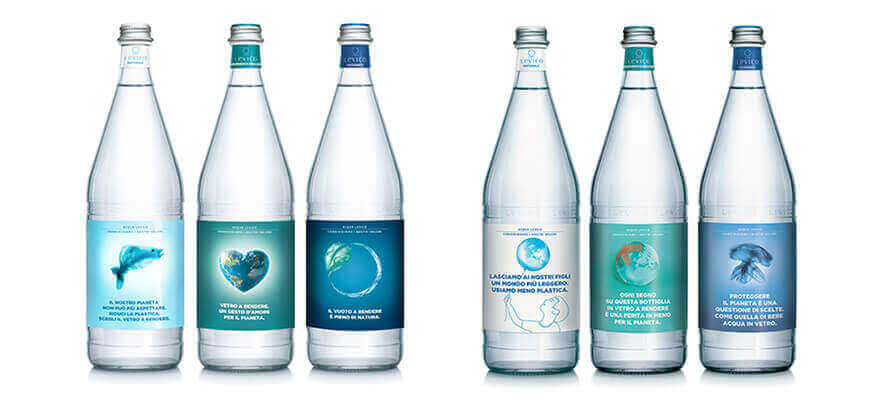
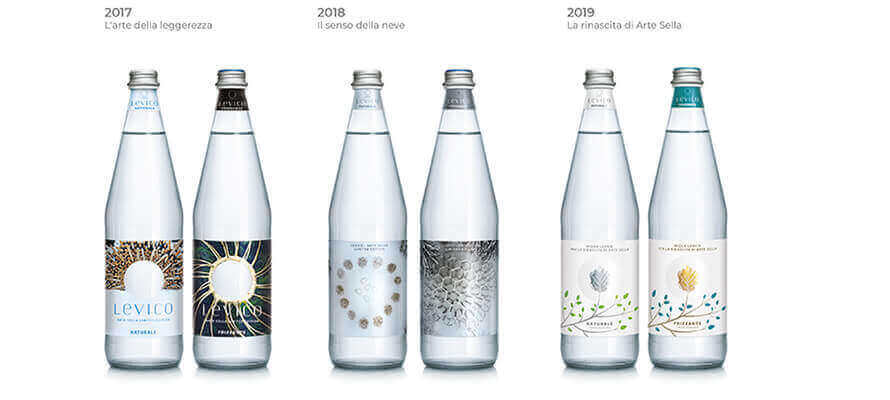
The labels created for Arte Sella from 2017 to 2019 were dedicated to highlighting the beauty – from the fir trees to the mountains, from the waters to the snow – of the Sella Valley and Valsugana, and affixed to 75 cl bottles for catering, including those printed for the desire for rebirth after the tragedy caused by storm Vaia. Those posters, which Franzoni anticipates will soon be inserted every seven bottles instead of twenty, have seen the 2020-2021 series communicate the sustainable value of returnable glass. This sustainability is also sought in the bottles (over the years made slightly less heavy without losing the protective and enhancing function of the glass content) and in the recycled plastic bottle holders.
Sustainability is also present in the self-adhesive labels that have also seen a limited production of designer bottles and have long been entrusted to a leading company in the sector such as La Prensa Etichette of San Giuliano Milanese. Mauro Franzoni defines it as “the correct balance between respect for the environment and the efficiency of a label that, when placed on a bottle, must resist water, ice and the cold of the refrigerator”.
So, concludes Stucchi, “we have opted for FSC-certified papers (B&B Brilliant one-side coated 80 gsm) with a low environmental impact, especially since the reuse of the bottles, during the crucial rewashing phase, requires the use of paper that can be easily broken down/recycled, with little water consumption because the bottles are washed with the same mineral water with which they are filled. And the same goes for the glue and inks, which of course, must be 100% non-polluting. Low migration inks based on resinous oils and without using varnishes or metallic effects for printing are the main culprits of pollution during washing. In the case of the “catering” line, in particular, the large presence of an unprinted white background and a central die means that there is even less ink and paper consumption with a minimalist design that is absolutely innovative in the mineral water sector”.
Levico Acque: a long history of love for nature
The history of Levico Acque is strongly linked to that of its local area, the Valsugana, which is rich in both ferruginous water (used for healing purposes in the spa facilities) and pure, light natural mineral water, which comes from a source other than the spa. This is what is still bottled today as Acqua Levico. The springs had been known since the 1600s; their commercial use began in 1860, while the historic core of the plant where the water is bottled – which started operating in 1961 – dates back to 1900. The “old” plant underwent its first renovation in 2007 and then in 2012-2013; the historic plant, located just a few metres from the Levico train station, has been renovated in an eco-sustainable way with high energy efficiency criteria. The environmental impact has been considerably reduced thanks to installing a 200 kW photovoltaic energy system that guarantees about 50% of the factory’s energy requirements, while the rest comes from renewable sources.
To reach the goal of the Società Benefit, and from this year of B Corp, Levico Acque’s journey began in 2005 with the transfer of its ownership to the Franzoni family. It is a path that has seen significant investments in making the historic Levico plant eco-sustainable. In 2013, at the plant’s inauguration, the first manifesto of values was presented, highlighting economic, environmental and social values as the three pillars of sustainability. At the same time, the new Levico water label was presented with the slogan “Sustainable lightness”.
In 2014, the company became the first in its sector with a plant with zero impact on the environment and obtained the “BNeutral” certification because the CO2 emissions of the Levico Terme plant were offset by sponsoring the algae remediation work carried out in the Venetian Lagoon by the Blue Valley sustainable fishing project.
Levico Acque subsequently decided to measure the overall environmental impact of the “product-bottle” throughout its life cycle in terms of CO2 emissions and particulate matter and water consumption with the LCA (Life Cycle Assessment) index. And after an initial process of emissions rationalisation, all those that could not be further decreased were offset by Levico Acque by financing reforestation and forest care initiatives. In 2019, the Trentino company thus obtained EPD (Environmental Product Declaration) certification and became the first “Climate Positive Water” in the world.