

Change the rules of the game so that everyone can play
Box
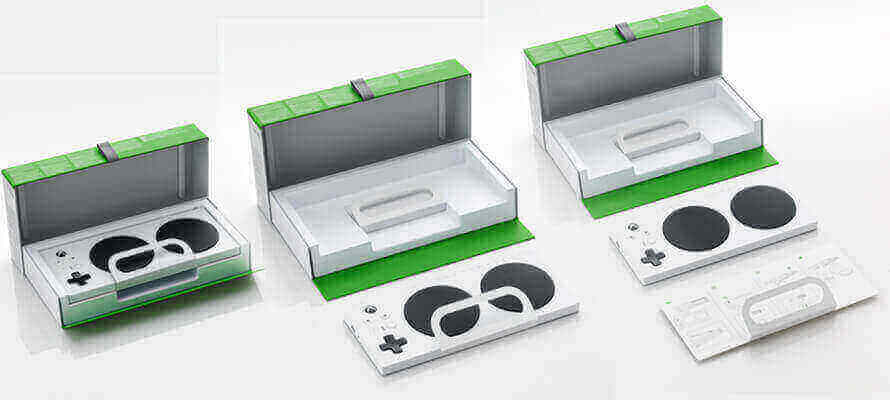
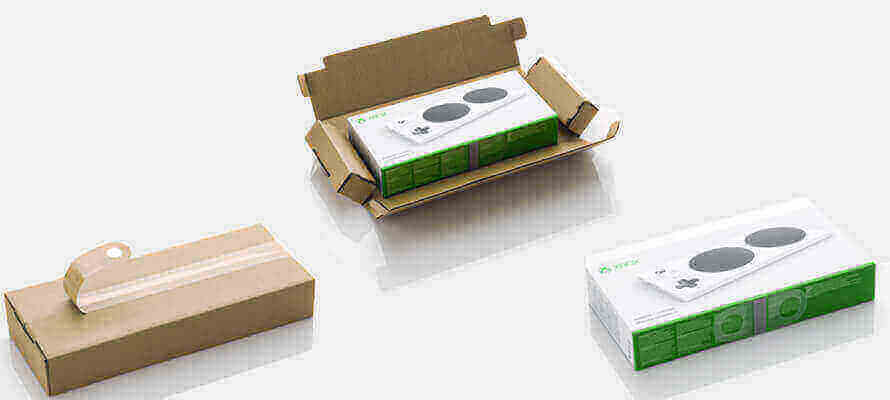
The key accessible features of the XBOX Adaptive Controller packaging
Both the single-shipper and retail package have been designed to unfold to reveal what’s inside with minimal friction. Discreet air cells integrated into the shipper packaging for protection for the product while maintaining a small footprint and clean design. Every major step of the unboxing incorporates loops, a highly proven lever to assist in accessibility.The leveraging of loops begins with the tear-strip on the single shipper, kicking off the out-of-box experience seamlessly. On the retail box, a specially designed ‘break-the-seal’ label (which keeps the box lid secured to the base) employs two loops, for multi-directional removal. A soft, grey loop initiates the opening experience, then there are integrated loops on both the paper Quick Start Guide (QSG) and cable folio. There are five loops on the XAC packaging from beginning to end. An open cavity area under the controller, enabling multiple ways to remove the controller from the box, including pulling via the loop or sliding it out directly. The box has a low center of gravity, grounding the unboxing experience and creating a sense of stability for the end-user. Additionally, the hinged lid provides a low-effort, single-pivot access into the package.
Change the rules of the game so that everyone can play. It’s what Microsoft did by making inclusive design part of the company’s DNA. It all started with the XBOX Adaptive Controller, which was developed starting from the user experience of people with disabilities. This approach revolutionised even the concept of packaging. We asked Kevin Marshall, Creative Director of Design, Global Packaging and Content for Microsoft, to tell us about the vision behind the XBOX Adaptive Controller, which can be unboxed quickly, without obstacles and safely. Not only did the project won the Pentawards Diamond ‘Best of show’ in 2019; it also made way for accessible packaging for every other Microsoft product, starting with the line for Holiday productivity, which will be launched in 2020.
By Michela Pibiri | On PRINT #80
—
How did you come to design the Xbox Adaptive Controller and its packaging? What is the vision behind it, the process and the needs it fulfills?
It’s predicted that by 2030 there will be approx. 8.5 billion people on the planet. But today, there are 1 billion people with disabilities. At Microsoft, we don’t believe in the traditional definition of disability: a disability is not a personal condition. Instead, we ascribe to a more inclusive belief that a disability is a mismatch in human interaction. That there is a spectrum – or continuum – of disability, and it ranges from permanent, to temporary to situational. And that by designing for one, your work can potentially help many. And it’s these beliefs, coupled with our commitment to Inclusion that led to the creation of our Adaptive Controller. So, a little background on the product.
For many gamers who have limited mobility, our traditional controller wasn’t built with them in mind. The controller is a barrier to joyful gaming. So several years ago, Microsoft announced its “Gaming for Everyone” vision. This vision was fueled by our CEO Satya’s passion for Inclusivity, and included new efforts to help device builders better understand the needs of those with varying levels of physical ability. And it was at that time that a first prototype of the Adaptive Controller was unveiled, and ultimately received funding. Now early on, my team realized that this package needed to be different. So much work had been put into the Adaptive Controller to make it as inclusive as possible, we beleived that the package also needed to be as accessible as it could be; it was an incredible opportunity to embody our mission of empowering every person on the planet. It quickly became clear that we should approach the creation of this packaging experience with fresh eyes. This required us to redefine our definition of packaging success, which began by asking the right questions. For instance: what physical realities might gamers with limited mobility be living with? What packaging experiences or elements could be meaningful? How could we best make this community feel conidered when unboxing our product? In order to answer these questions and address their potential, we made a deep effort to design with continual input from gamers with limited mobility. The insights from these gamers was critical to shaping a meinagful package. Our vision was to deliver the most accessible, inclusive package we could, and possibly deliver an example of how inclusive packaging design could be approached.
Mark Weiser, my lead packaging designer on this project, did a phenomenal job partnering with our Xbox Product Research Team as well as several non-profits such as Able Gamers and Special Effects, the veteran-focused charity War Fighters Engaged and the Cerebral Palsy Foundation. We even engaged with Craig Hospital, a Denver, Colorado-based rehabilitation center for brain and spinal cord injuries. These partnerships and the learnings coming out of them are the reason the XAC package became what it is. We were so lucky – and grateful – to have had the opportunity to learn from these extraordinary people.
The mantra “Nothing about us without us,” has been around for quite some time and underscores the conviction that people with disabilities know what’s best for them – and that an enlightened creative process will include them as participants. Their voice matters and they need to be out front and center as visible leaders. So we really ascribed to this saying, doing all we could to deisgn and iterate with gamers with limited mobility rather than just design based on our instincts alone, or past experiences. And this inclusive approcah made all the difference. The lesson coming out of this, is that it can be so much more powerful to design with your consumer rather than for your consumer.
So, fundamentally this package is the output of lots of partnership, the courage to build differently, the humility to admit we didn’t know everything and a commitment to delivering an inclusive, human experience.”
Are there any other Microsoft packs that were designed according to the same criteria or is there something new in the pipeline?
Absolutely. Microsoft is totally committed to driving inclusive design thinking into our product experiernces. There are teams across the business looking at ways – both immediate and long term – to amplify inclusive attributes across our portfolio. The Packaging and Content design team (PAC) is a part of many of these sprints. Inclusivity – as well as Sustainbility – is a big part of of the DNA of every package we now create.
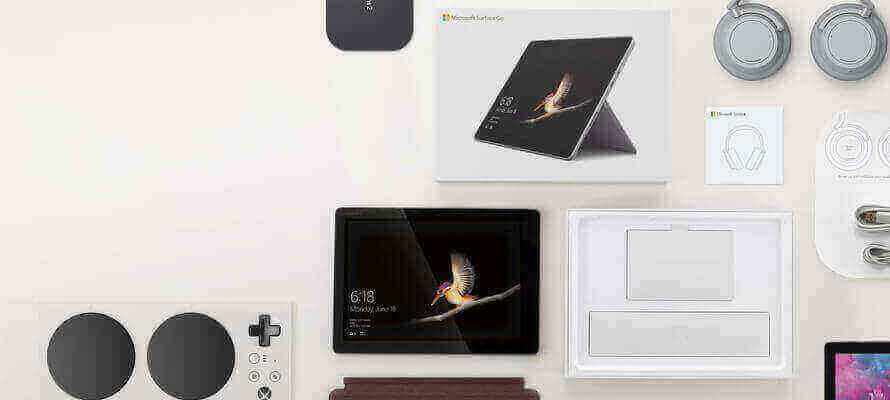
PAC has taken the learnings from our Adaptive Controller packaging and are incorporating these learnings into a new suite of inclusive elements for our Holiday productivity device packages. For instance, you’ll see larger pull tabs for easier product evacuation, more generous access holes across in-box accerssories and refreshed, higher-contrast iconography on device wraps to increase visibility and legibility of product features at a glance. We’re leveraging the power of loops – a direct translation of the work on the Adaptive Controller package – in our cable boxes to facilitate easier removal. These are just a couple examples.
And we continue to innovate; we’re working on a second wave of inclusive elements for upcoming launches, and learning every day. We’re incredibly passionate about moving the needle in this important arena, and committed to do so.
Is it possible to imagine a future in which everything will be designed taking into account everyone’s needs, will be able to engage with diversity and truly improve everyone’s lives?
A future where designs and experiences are more holistically considered and inclusive? Yes! I believe whole heartedly that such a future is possible! And we’re already on our way. Inclusive design thinking is now stretching in every possible direction; it’s not just one type of experience. It can be physical, digital, audible, virtual – there are so many new ways to be inclusive and to connect in meaningful ways with our consumers that to conceive and create experiences today without that lens in place feels archaic.
People want experiences that reflect their own values, and being accessible is fundamentally human. We all have a stake in this game – we all want to feel considered and included. But it’s important as creators to remember that we can’t do it in a vaccuum. We need to include those we’re designing for in our process, otherwise we run the risk of creating hollow moments or experiences that don’t land as imagined. It all begins with a mindset. If you’re not thinking inclusively, if you’re not mindefully inclusive as a designer, then you’re automatically excluding folks, and that’s a missed opportunty.
As I mentioned, one of our inclusive values is ‘Design for one, extend to many’, and what that means is that by creating packaging experiences that solve potential challenges for one group of consumers, those benefits can easily extend beyond that group to so many more people. It’s incredily powerful to consider that by addessing the needs of a select community everyone can benefit; everybody’s lives can be improved. As I said, our company mission is ‘To empower every person and orgainzation on the planet to achieve more’, and as designers we have tremendous repsonsibility to make good on that promise. It’s our job to manifest this potential in product experiences in every way possible, and that often starts with the packaging journey.
Nowadays consumers expect businesses to take on meaningful roles in helping to tackle world issues. What is the Microsoft committment, and do you believe that the huge resonance of the this project can be a push toward innovation and a change of mindset on a global scale?
You’re absolutely right. Consumers expect more from the brands they support today – and they should. Brands need to ask themselves if they’re really creating better products and experiences, and are they contributing towards a greater good in some meaningful and authentic way. Microsoft believes in the potential in utilizing technology to build platforms and opportunities to help make lasting, positive impact. There’s a true focus on corporate social responsibility at Microsoft, and while there are those in the orgainzation much better suited to speak to the details of our values and practices in those areas, I can tell you that not a day goes by in packaging design where we’re not discussing and challneging ourselves to link our creative thinking to a more sustainbile, inclusive future.
Which is why now, more than ever, inclusivity and sustainability sit central to how we see our work, and the kind of packaging experiences we want to create. Of course, there are always business realities that need consideration; but we continue as a team to push forward with providing the best and most balanced experiences we can. There is so much more to do, but I’m proud of the initial progress my team has made. This takes time and lots of partnership, and the ability to be agile, but we feel very grateful to have the chance to participate in and shape these kinds of dialogues. We’re excited to push forward in that spirit.
—
Kevin Marshall
As Micros oft’s Creative Director of Global Packaging and Content, Kevin leads a world-class team of designers and is responsible for the vision and creative strategy of Microsoft’s packaging for its worldwide line of products, including Surface, XBOX, Hololens, PC Hardware, Windows and others. He believes that intuitive, well-crafted packaging is one of a brand’s most vital assets in creating meaningful and lasting consumer relationships, and that delivering seamless physical and digital touchpoints across the consumer journey is central to the success of a modern product experience.Prior to joining Microsoft, he was Creative Director of Marc Rosen Associates, a New York based, award-winning design firm specializing in luxury, beauty and consumer packaged goods. Prior to that, he was Global Packaging Design Director for Avon Products, Inc. responsible for packaging across global brands.