Print mix in retail: Fespa Italia research
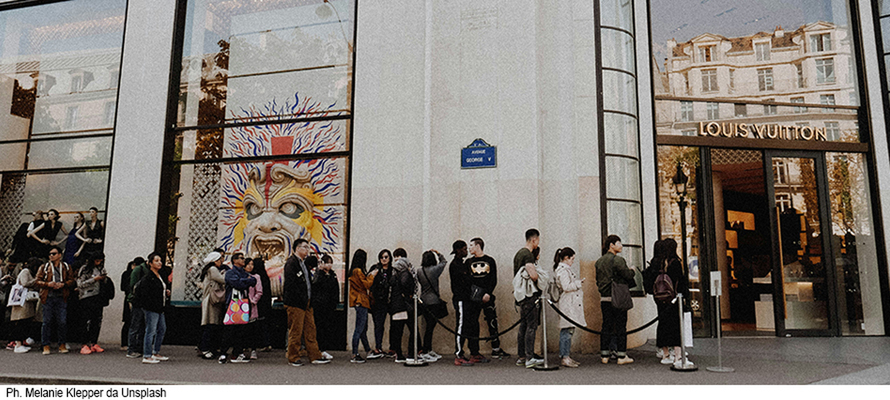
The new edition of the “Print and Retail” survey, conducted by Fespa Italia two and a half years after the first in spring 2023, focuses on large-format print suppliers for the retail market. The data, previewed on December 10 during Fespa Daylight in Milan, confirms that physical stores remain a key hub for brands, but with an increasingly tactical, modular, and immediate impact-driven role. Here is a summary of the research findings.
By Michela Pibiri | on PRINTlovers 108
Product sectors. A comparison with 2023 shows a rebalancing in the product sectors served by retail printing. Traditionally strong sectors such as food and design are maintaining their position, while high-end fashion and jewellery—probably related to the contraction in the luxury market—homecare, and sportswear, which were more prominent in 2023, are declining. This trend indicates increased caution in brand investments in these segments and a focus of suppliers on customers with consistent volumes and high turnover. Retail printing, therefore, becomes less experimental and more industrial, tied to production continuity.
Distribution channels. In terms of distribution, the most notable figure is the decline in corners in specialized multi-brand stores (-19.64%), indicating a gradual withdrawal of brands from shared spaces. Single-brand stores and large-scale retail remain the primary destinations for print production, confirming a trend already evident in 2023: increased control of the environment, greater standardization, and less dispersion of the message.
Applications. Analysis of applications shows a clear shift toward high-visibility front solutions. Scenic window displays increased by +13.39%, while applications related to permanent furnishings and display systems declined. Retail appears to favour quick, seasonal, and easily replaceable displays, consistent with a more “event-based” communication model. The frequency of renewal shows no significant changes but reinforces an existing trend: more frequent updates of “soft” decorative surfaces and front communication, with low operational impact. Printing becomes a tool for rapid activation rather than a stable infrastructure for the space.
Sustainability. However, it is on the sustainability front that the comparison with 2023 reveals the most obvious critical issues. While two years ago most suppliers stated that many customers were asking for eco-sustainable solutions, in 2025 the picture is polarized: 62.5% say that only a few customers request them, while the proportion of those working with brands that always demand them is growing. At the same time, there is a significant increase (+31%) in the number of companies unwilling to spend more on sustainable products, compared with the average cost of green solutions, which rose from +21.5% in 2023 to +25% in 2025. End-of-life management also remains an unresolved issue: in most cases, customers do not adopt structured practices, and 75% of suppliers do not offer collection and disposal services, up from 62% in 2023. Sustainability, while still a stated concern, appears less strategic and less communicated at the brand level than two and a half years ago, probably due to the increasingly complex geopolitical situation, which has a clear impact on energy costs, and a changed political climate at the international and European levels, with the US withdrawing from the Paris Agreement and the European Commission backtracking on some of the Green Deal's objectives.
Personalization. Data on personalization offers one of the most interesting perspectives of the 2025 edition. On the one hand, standardization is increasing: the number of companies that do not differentiate between points of sale has risen by 15 percentage points. This trend can be linked to creative centralization, cost rationalization, and the need to simplify campaign management. Conversely, there is a surge in demand for personalization connected to limited editions, which is growing by 44 percentage points. Retail appears to be moving away from widespread personalization toward focusing it at specific moments of high symbolic and narrative importance. This involves fewer structural changes and more targeted interventions that generate attention and a sense of exclusivity. The outcome is an increasingly “event-driven” store model, where print becomes a key tool for activating temporary micro-experiences, aligned with the seasonal changes in the offering and the audience’s desire for novelty, recognizability, and continuous updates—without operational complexity.
Substrates. In 2023, aggregate data by application clearly show a dominance of plastic and synthetic substrates, chosen for their reliability, aesthetic appeal, and ability to adapt to frequent renewal cycles. PVC is clearly the top choice. This is followed by Forex, which remains one of the most widely used structural substrates for displays, totems, and front-facing communication. Both serve as the material backbone of modern printed retail. Corrugated cardboard ranks third, followed by foam board and synthetic fabrics. These materials fulfil different but overlapping needs: lightness, ease of handling, adaptability for temporary installations, and a good balance between cost and visual impact. When sustainability is a factor, it is typically achieved not through radical changes in substrates but through more efficient and extended use of the same materials.
Inks. When examining ink technologies more closely, the picture becomes even clearer. UV inks are clearly dominant, accounting for the largest share (around 45-50% of the total), followed by latex inks (around 30%). Water-based and sublimation inks trail behind, while eco-solvent, solvent, and screen printing inks hold smaller shares. Reactive and pigmented technologies are nearly non-existent. The emphasis on UV and latex reflects a clear preference for solutions that offer quick drying, wide substrate compatibility, durability, and versatile application.
Finishing. The most common finishing technique is die cutting, used by over 60%, followed by gloss or matte varnishing at around 55%, and folding or creasing at over 40%. Laser cutting and spot varnishing are next, both at approximately 30-35%. More decorative or specialized techniques – such as metallization, flocking, stitching, or embroidery — remain below 15%, while engraving and special varnishing occupy middle positions. The data clearly shows that finishing is mainly functional, providing shape, structure, and recognizability to the material, but the significance of visual and material effects remains strategic.
A technical grammar consistent with “fast” retail
In summary, the FESPA data reveals a technical grammar that aligns with a retail sector that is becoming more seasonal, temporary, and event-focused. Printing continues to be key to the in-store experience but is declining in importance, especially regarding sustainability. This realistic view encourages us to prioritize the quality of design and strategic decisions over the volume of printing produced.
By Michela Pibiri | on PRINTlovers 108
Product sectors. A comparison with 2023 shows a rebalancing in the product sectors served by retail printing. Traditionally strong sectors such as food and design are maintaining their position, while high-end fashion and jewellery—probably related to the contraction in the luxury market—homecare, and sportswear, which were more prominent in 2023, are declining. This trend indicates increased caution in brand investments in these segments and a focus of suppliers on customers with consistent volumes and high turnover. Retail printing, therefore, becomes less experimental and more industrial, tied to production continuity.
Distribution channels. In terms of distribution, the most notable figure is the decline in corners in specialized multi-brand stores (-19.64%), indicating a gradual withdrawal of brands from shared spaces. Single-brand stores and large-scale retail remain the primary destinations for print production, confirming a trend already evident in 2023: increased control of the environment, greater standardization, and less dispersion of the message.
Applications. Analysis of applications shows a clear shift toward high-visibility front solutions. Scenic window displays increased by +13.39%, while applications related to permanent furnishings and display systems declined. Retail appears to favour quick, seasonal, and easily replaceable displays, consistent with a more “event-based” communication model. The frequency of renewal shows no significant changes but reinforces an existing trend: more frequent updates of “soft” decorative surfaces and front communication, with low operational impact. Printing becomes a tool for rapid activation rather than a stable infrastructure for the space.
Sustainability. However, it is on the sustainability front that the comparison with 2023 reveals the most obvious critical issues. While two years ago most suppliers stated that many customers were asking for eco-sustainable solutions, in 2025 the picture is polarized: 62.5% say that only a few customers request them, while the proportion of those working with brands that always demand them is growing. At the same time, there is a significant increase (+31%) in the number of companies unwilling to spend more on sustainable products, compared with the average cost of green solutions, which rose from +21.5% in 2023 to +25% in 2025. End-of-life management also remains an unresolved issue: in most cases, customers do not adopt structured practices, and 75% of suppliers do not offer collection and disposal services, up from 62% in 2023. Sustainability, while still a stated concern, appears less strategic and less communicated at the brand level than two and a half years ago, probably due to the increasingly complex geopolitical situation, which has a clear impact on energy costs, and a changed political climate at the international and European levels, with the US withdrawing from the Paris Agreement and the European Commission backtracking on some of the Green Deal's objectives.
Personalization. Data on personalization offers one of the most interesting perspectives of the 2025 edition. On the one hand, standardization is increasing: the number of companies that do not differentiate between points of sale has risen by 15 percentage points. This trend can be linked to creative centralization, cost rationalization, and the need to simplify campaign management. Conversely, there is a surge in demand for personalization connected to limited editions, which is growing by 44 percentage points. Retail appears to be moving away from widespread personalization toward focusing it at specific moments of high symbolic and narrative importance. This involves fewer structural changes and more targeted interventions that generate attention and a sense of exclusivity. The outcome is an increasingly “event-driven” store model, where print becomes a key tool for activating temporary micro-experiences, aligned with the seasonal changes in the offering and the audience’s desire for novelty, recognizability, and continuous updates—without operational complexity.
Substrates. In 2023, aggregate data by application clearly show a dominance of plastic and synthetic substrates, chosen for their reliability, aesthetic appeal, and ability to adapt to frequent renewal cycles. PVC is clearly the top choice. This is followed by Forex, which remains one of the most widely used structural substrates for displays, totems, and front-facing communication. Both serve as the material backbone of modern printed retail. Corrugated cardboard ranks third, followed by foam board and synthetic fabrics. These materials fulfil different but overlapping needs: lightness, ease of handling, adaptability for temporary installations, and a good balance between cost and visual impact. When sustainability is a factor, it is typically achieved not through radical changes in substrates but through more efficient and extended use of the same materials.
Inks. When examining ink technologies more closely, the picture becomes even clearer. UV inks are clearly dominant, accounting for the largest share (around 45-50% of the total), followed by latex inks (around 30%). Water-based and sublimation inks trail behind, while eco-solvent, solvent, and screen printing inks hold smaller shares. Reactive and pigmented technologies are nearly non-existent. The emphasis on UV and latex reflects a clear preference for solutions that offer quick drying, wide substrate compatibility, durability, and versatile application.
Finishing. The most common finishing technique is die cutting, used by over 60%, followed by gloss or matte varnishing at around 55%, and folding or creasing at over 40%. Laser cutting and spot varnishing are next, both at approximately 30-35%. More decorative or specialized techniques – such as metallization, flocking, stitching, or embroidery — remain below 15%, while engraving and special varnishing occupy middle positions. The data clearly shows that finishing is mainly functional, providing shape, structure, and recognizability to the material, but the significance of visual and material effects remains strategic.
A technical grammar consistent with “fast” retail
In summary, the FESPA data reveals a technical grammar that aligns with a retail sector that is becoming more seasonal, temporary, and event-focused. Printing continues to be key to the in-store experience but is declining in importance, especially regarding sustainability. This realistic view encourages us to prioritize the quality of design and strategic decisions over the volume of printing produced.
06/02/2026


